Adomate Nailed My Brand (But Made Up My Customers)
7 min read · about Adomate ·

Adomate Nailed My Brand (But Made Up My Customers)
It read my site and got my business right. Eight minutes in, my first ads put four invented people next to my real clients.
1 / 29

Written by
Eddy Bogomolov
Product designer for B2B free trials
Published
What you'll learn
- How Adomate asks its questions while it reads your site, and why that works
- Why a product URL step after a full site read costs more than the seconds it takes
- Why the first output of an AI trial has to be one you could publish, not just one that impresses
Adomate’s homepage asks for one thing: my website. Give it a URL, it says, and it turns “data into winning ads”. Eight minutes later I had nine ads, and I couldn’t publish one of them.
Adomate Nailed My Brand (But Made Up My Customers), chapter by chapter
Adomate's homepage asks for one thing: my website. Give it a URL, it says, and it turns "data into winning ads". Eight minutes later I had nine ads, and I couldn't publish one of them.
In this story I'm me: a one-person product design consultancy that fixes SaaS free trials. I run Meta ads, so I have performance data, but I have no designer for ad creatives.
So I recorded my screen from the homepage to the first ads. Adomate got my brand right. The problem is what it did with it.
What I found:
- A URL-first homepage and questions asked while it reads my site. The setup is the best I've seen in an AI trial.
- Then it asks for a product URL it could have found, and five of the eight minutes to the first ad are loading screens.
- The first ads use my real clients' names, next to four people who don't exist and other companies' logos. "Publish-ready ads" I can't publish.
Let's get into it.
1. The promise: my data, then just my URL
Meet me. I'm a one-person design consultancy: I fix SaaS free trials. I run my own Meta ads, so I have performance data. What I don't have is a designer for ads.
Adomate's homepage:
"Turn data into winning ads. At scale."
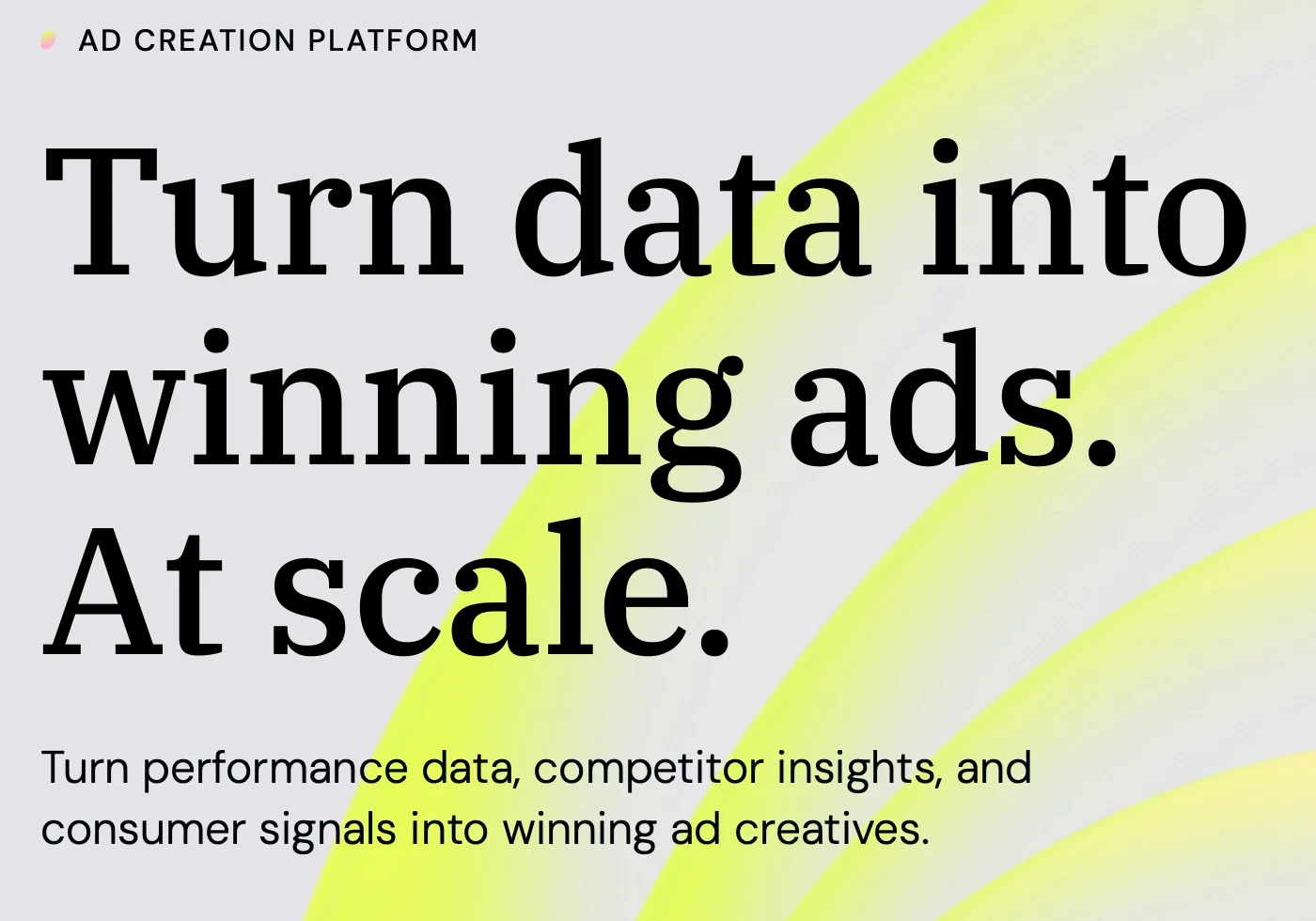
Under it: "Turn performance data, competitor insights, and consumer signals into winning ad creatives." That's exactly what I want: I run Meta ads, so I have that data. Then the box under it asks only for my website. Where does my data come in?
The film next to it says it better than the words do. Ads swirl around the logo. Then they come one at a time, with "Dislike" and "Like". The one I like goes "Live on Meta · Active", in a Facebook feed.
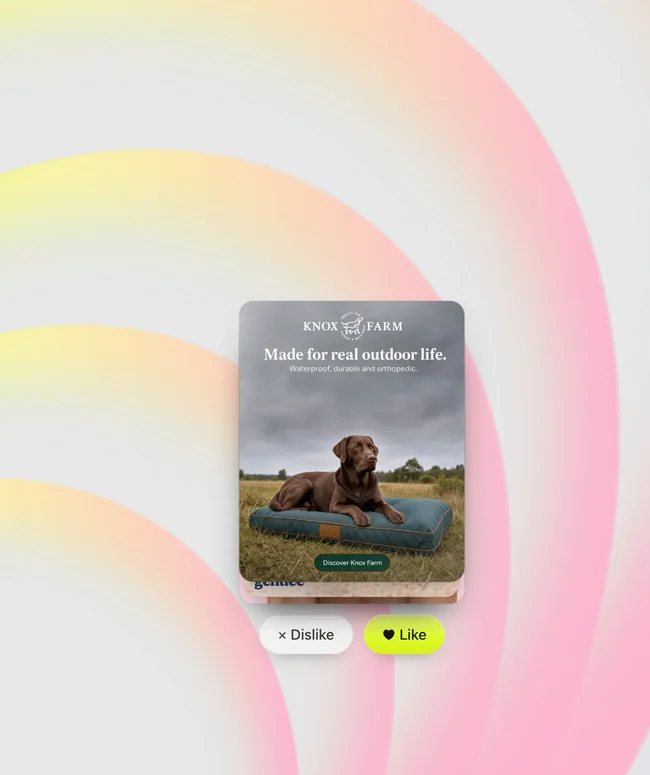
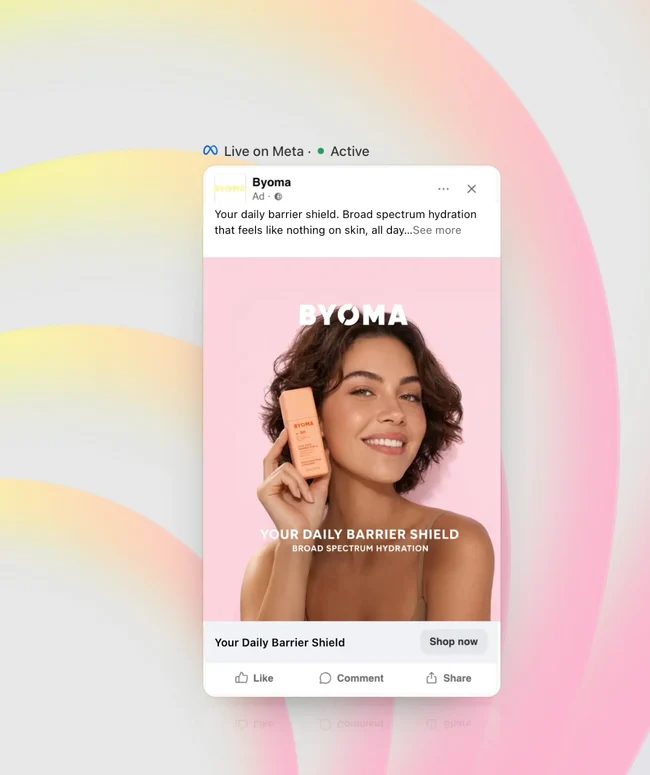
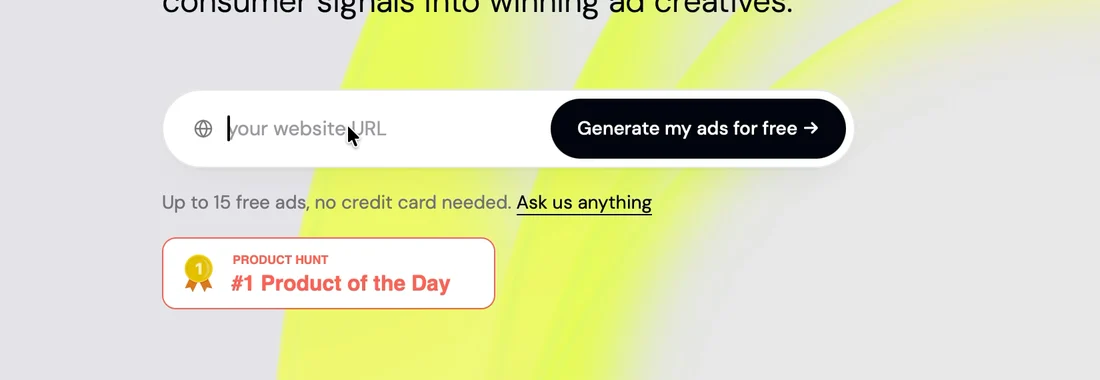
Still, the first step is easy: one box for my website, and "Up to 15 free ads, no credit card needed." Quick to start, even if it isn't the data the headline promised. No sign-up form first. I paste my URL and click "Generate my ads for free".
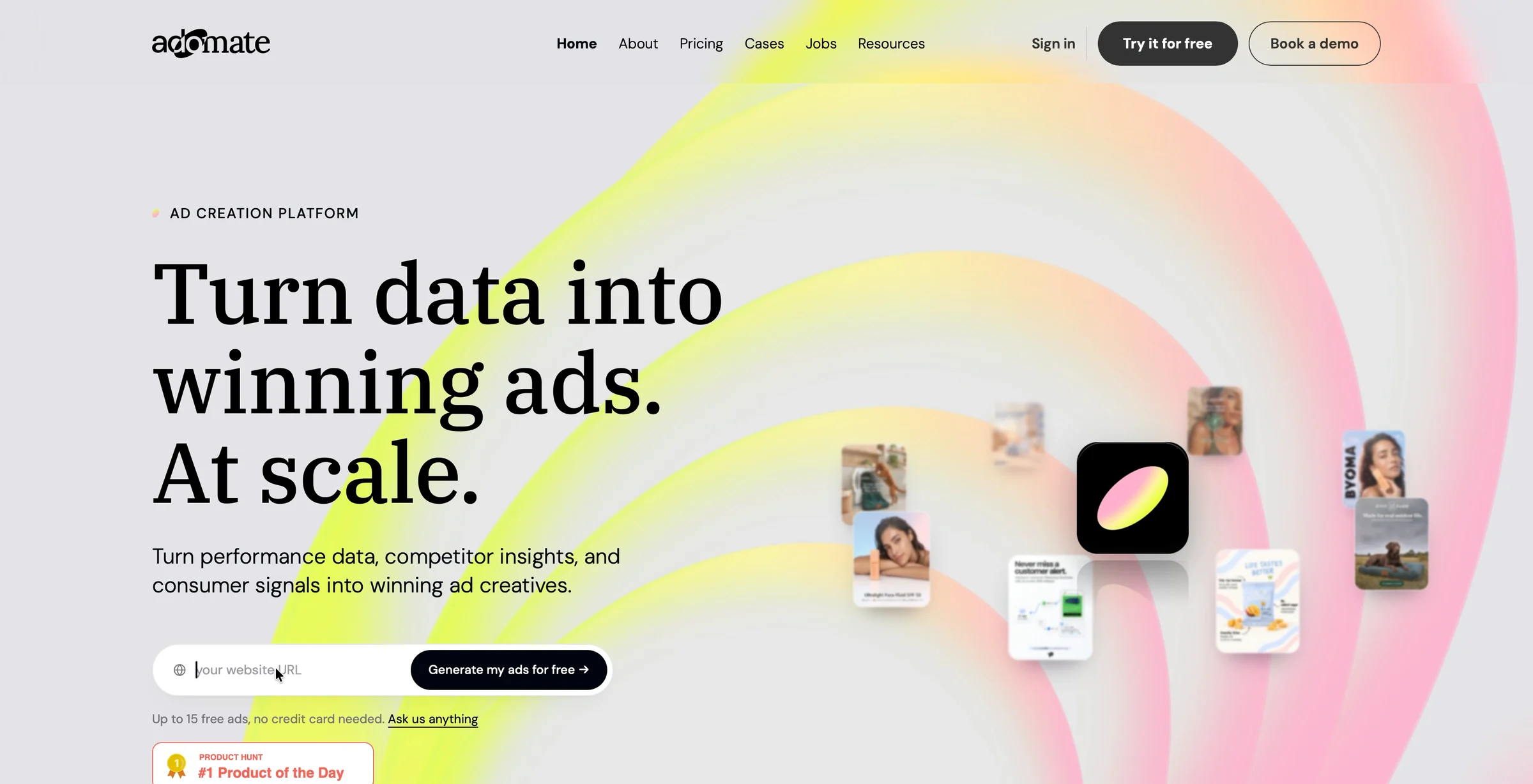
Under the box, the only proof is a Product Hunt badge: "#1 Product of the Day". It tells me tech people upvoted Adomate. It doesn't tell me the ads work for a small brand like mine.
Sign up with Google. And a nice touch on the right: my URL is already in the diagram, "Your brand: edijsbogomolovs.com".
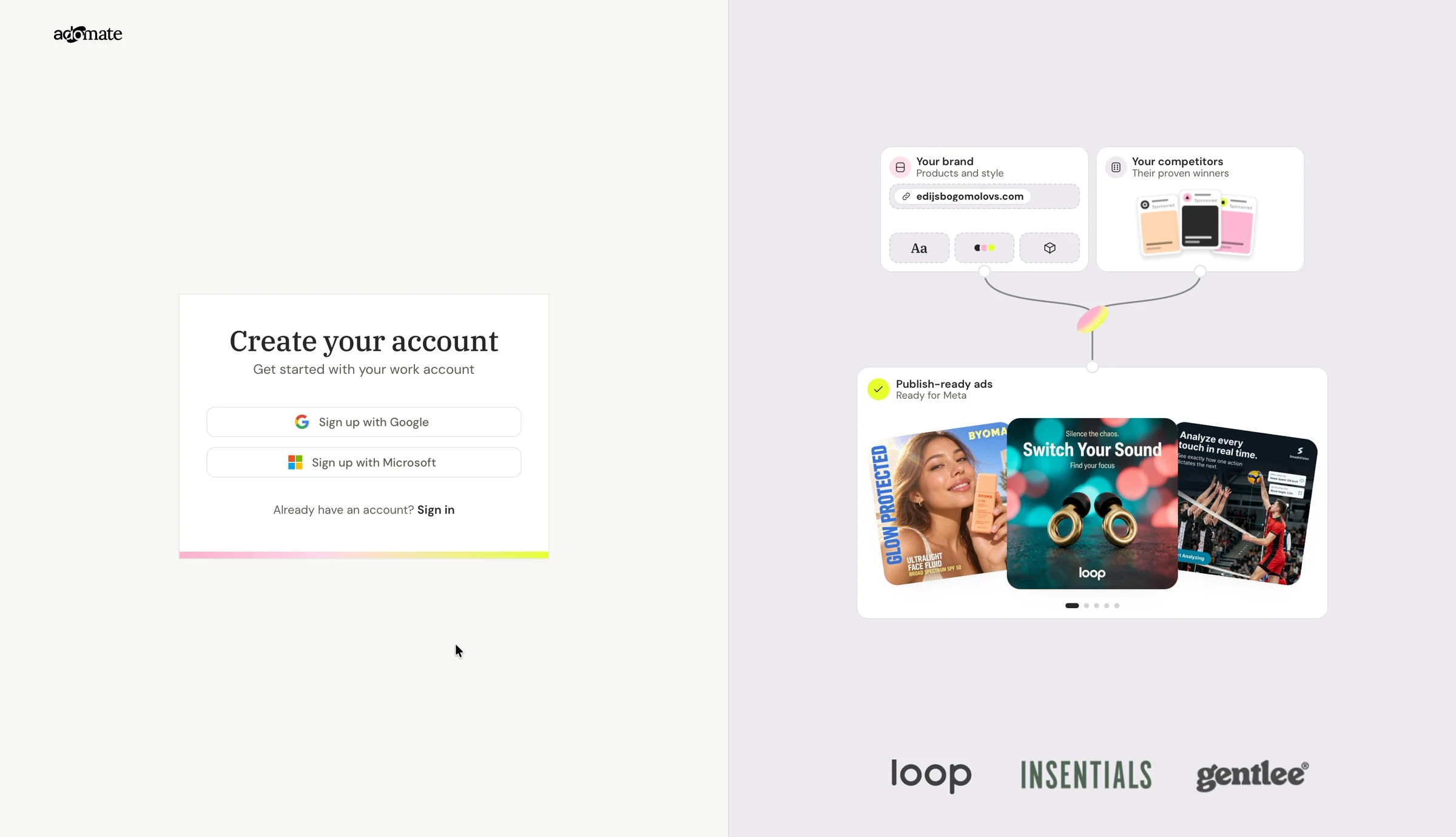
Now compare the two pages. The homepage shows a Product Hunt badge. The sign-up page shows customer logos: loop, Insentials and gentlee. The better proof comes after I've decided to try it.

2. The setup: it asks while it reads
Five quick questions: am I running Meta ads now, who makes them, how many a month, what I spend, which tools I use. Under each one: "Scanning your landing page…"
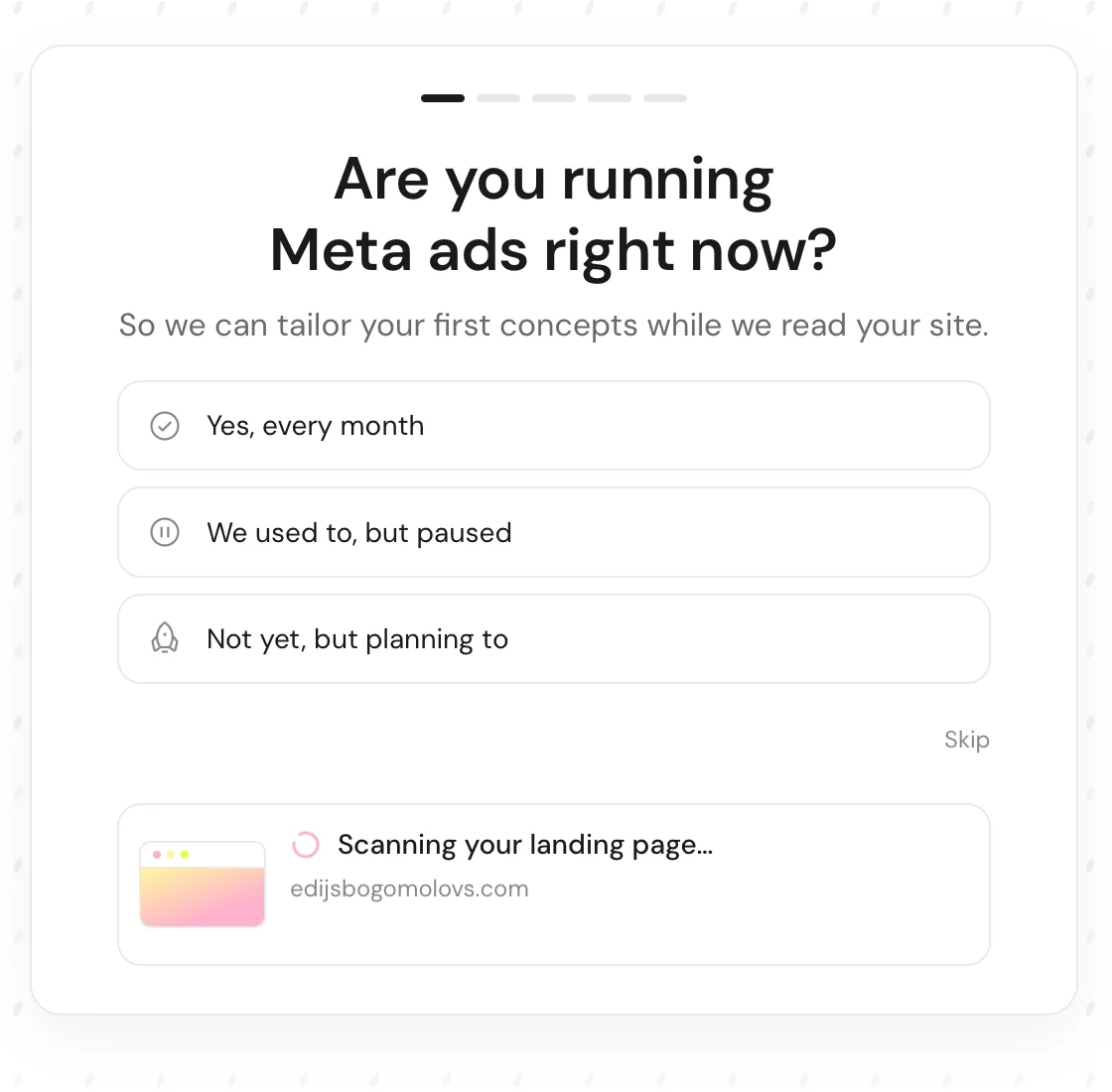
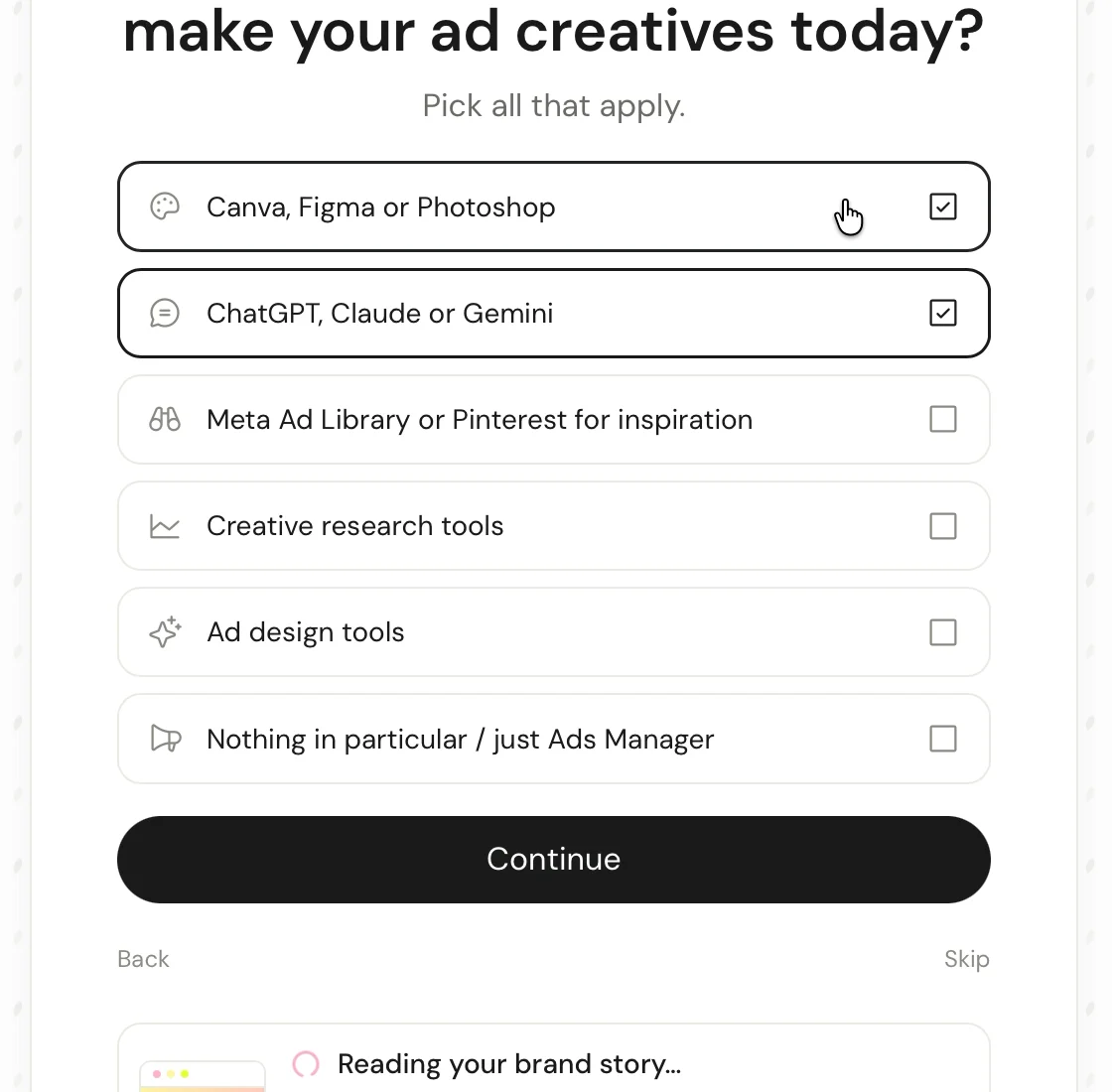
It asks while it works. I don't wait for a single question.
Then I watch my own homepage scroll by: "Reading your brand story… Building your Brand Brain… ~1m00 remaining".
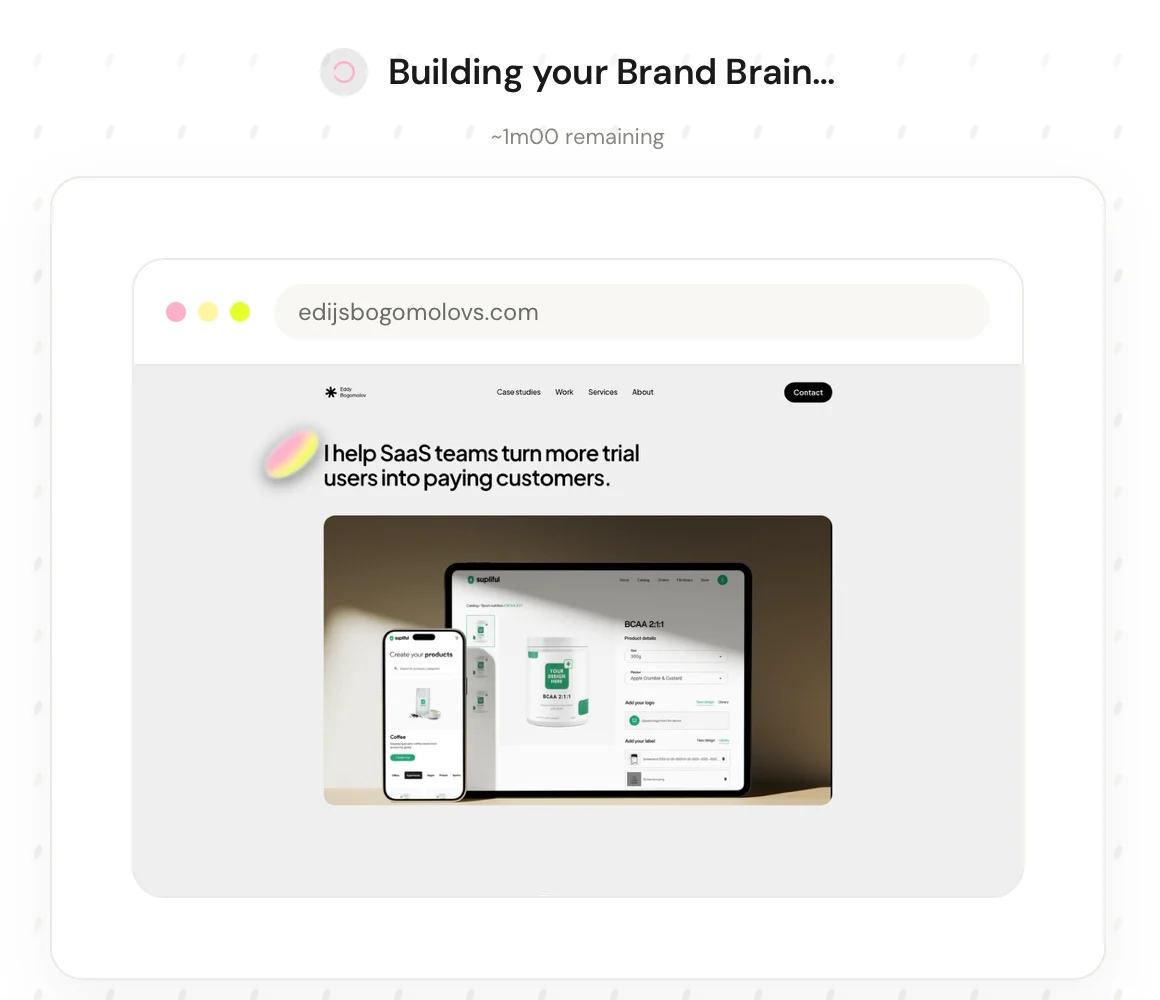
80 seconds. The countdown is honest, and the scrolling site tells me it's really reading. Still: 80 seconds.

"Here's what we learned about your brand."
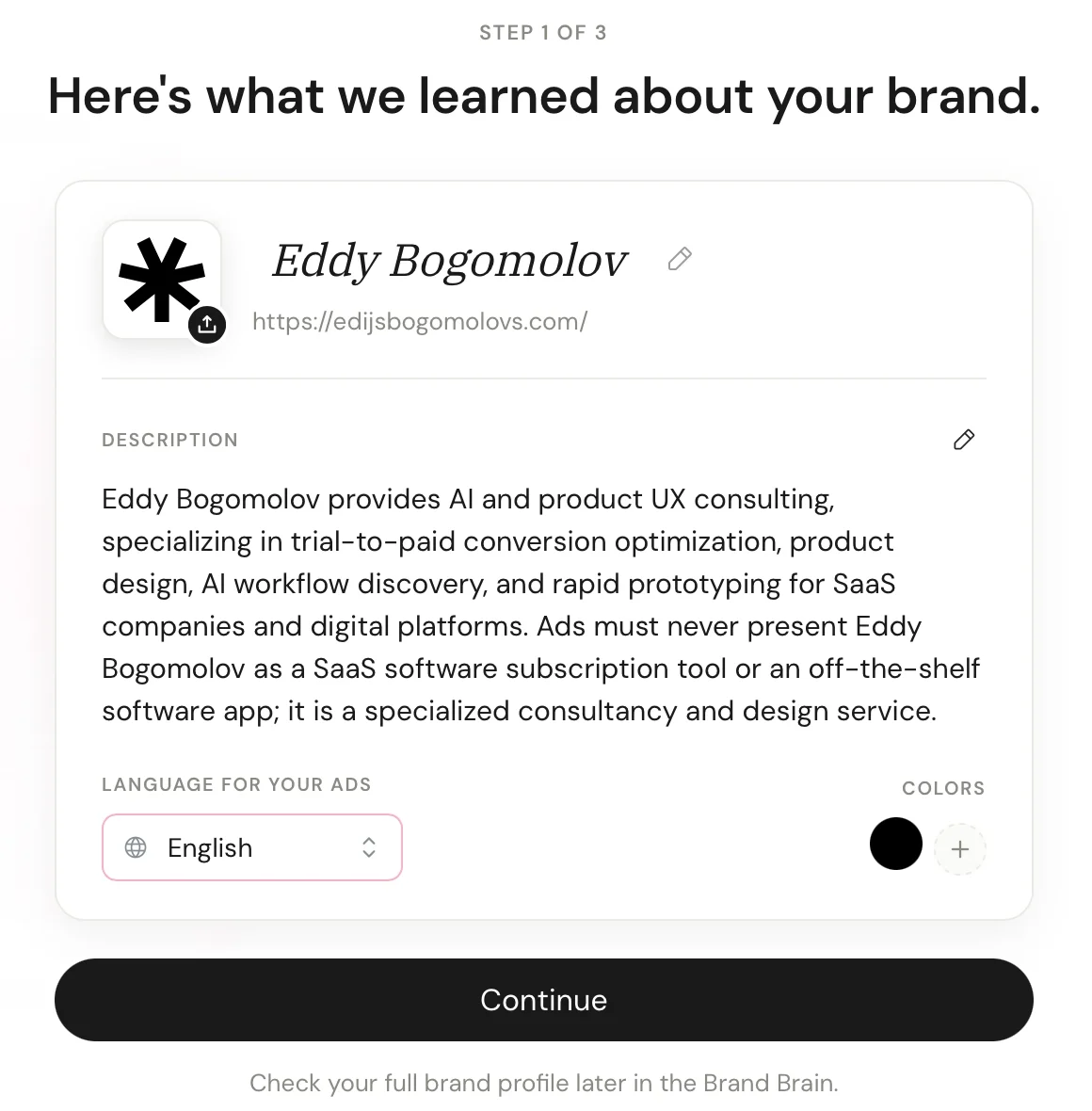
It's right. Better than my own LinkedIn headline: "AI and product UX consulting, specializing in trial-to-paid conversion optimization." It even wrote itself a rule: "Ads must never present Eddy Bogomolov as a SaaS software subscription tool or an off-the-shelf software app; it is a specialized consultancy and design service."
Remember that rule.
3. The product step: a URL it already had
Step 2 of 3: "What are you advertising?" A product URL, with acme.com as the example.
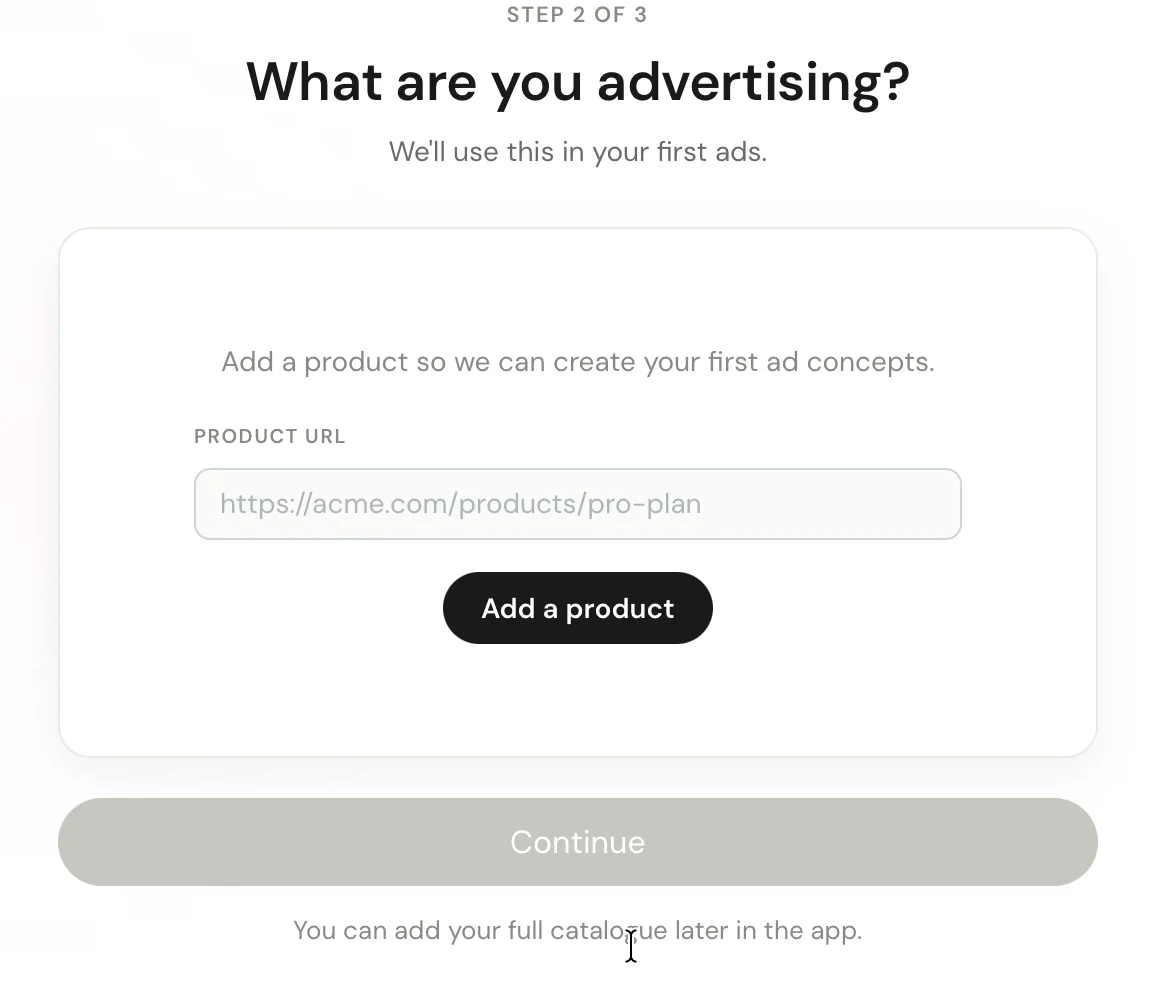
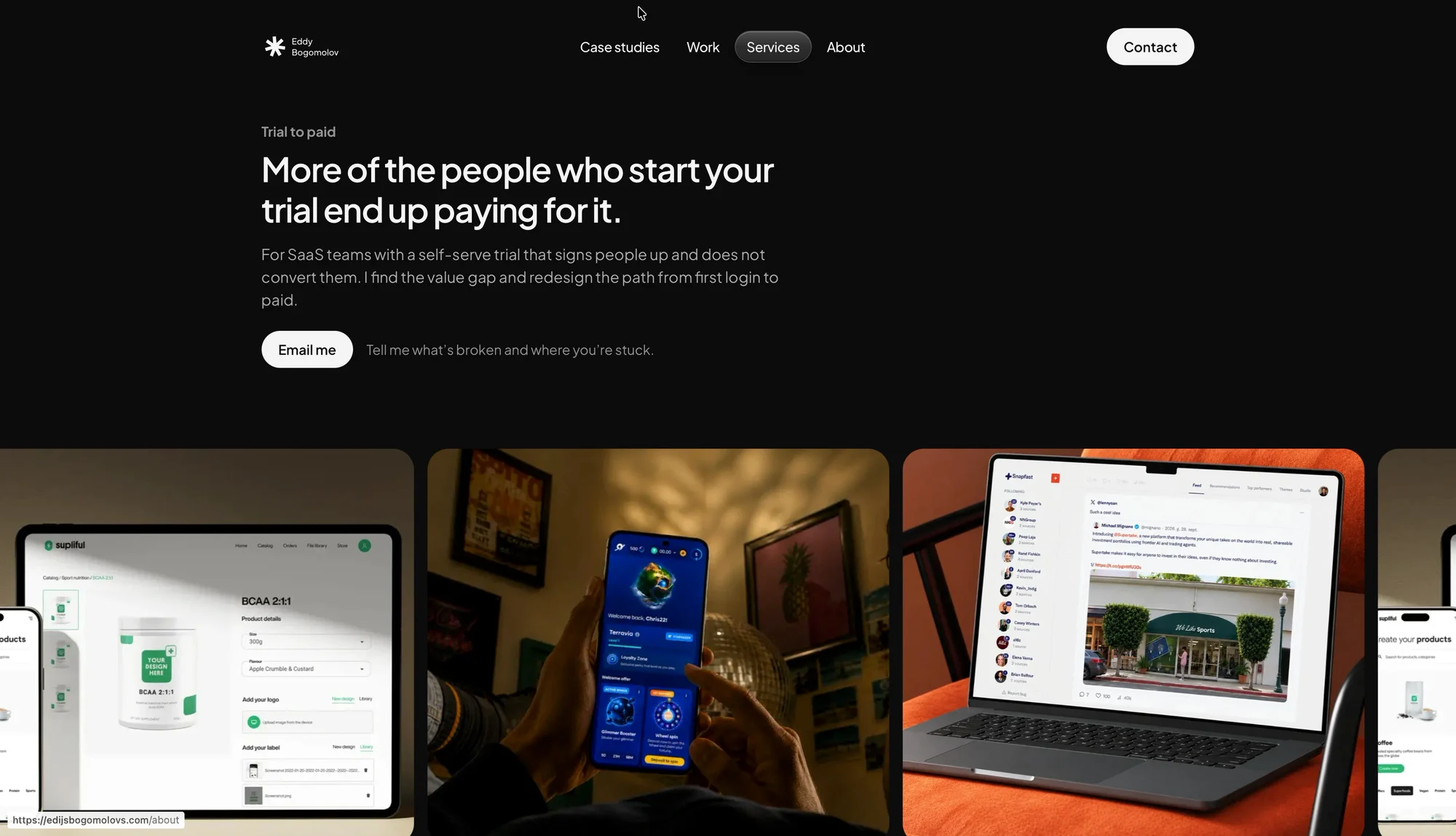
It just read my whole site. I open a new tab, go to my own site, click Services, then Trial to paid, copy the link and come back.
Another 80 seconds: "Analyzing your product page… Extracting product details & pricing… Researching your market & similar brands… Identifying key selling points… Crafting your product positioning…"
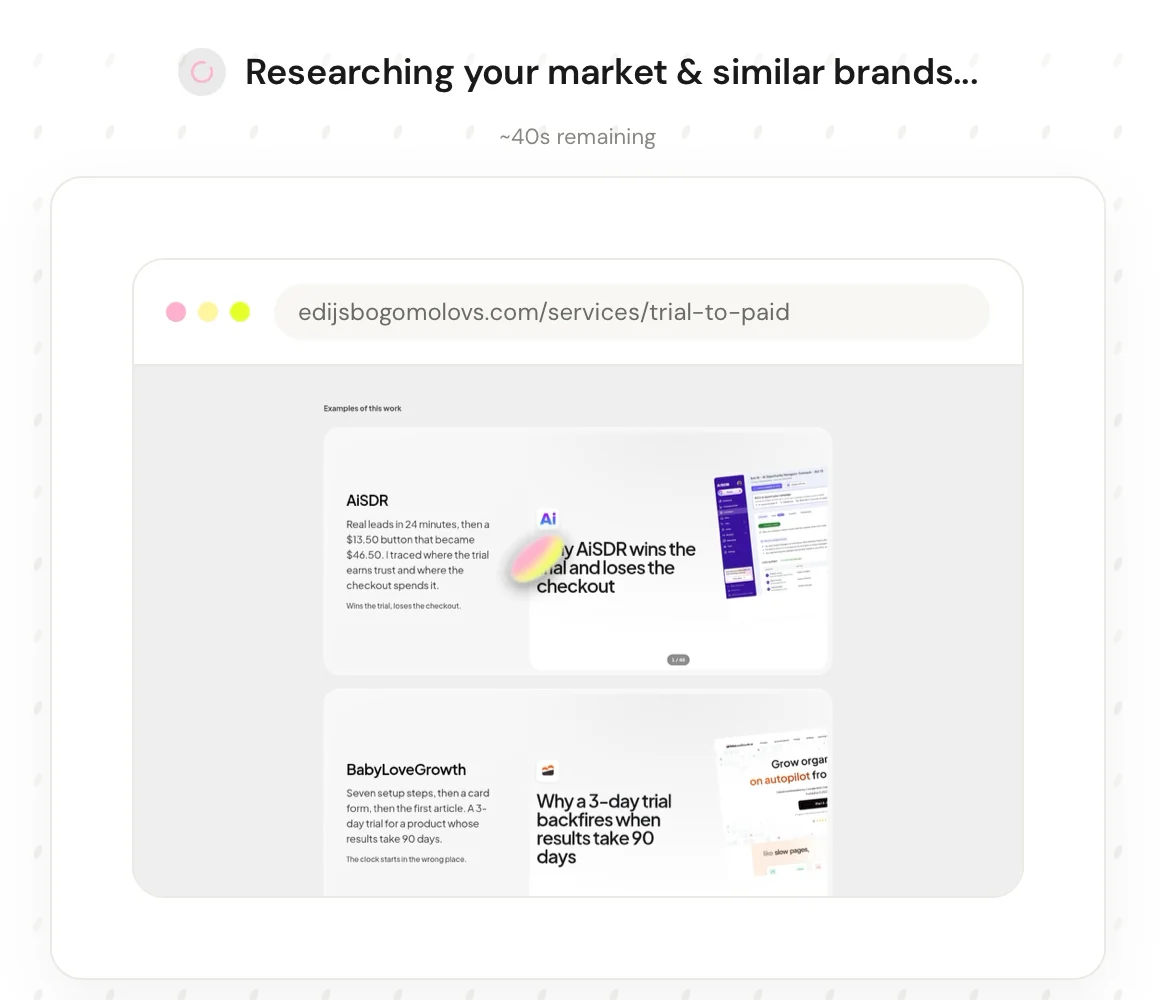
And it's right again: Trial to Paid, five key features, each one a line from my page.
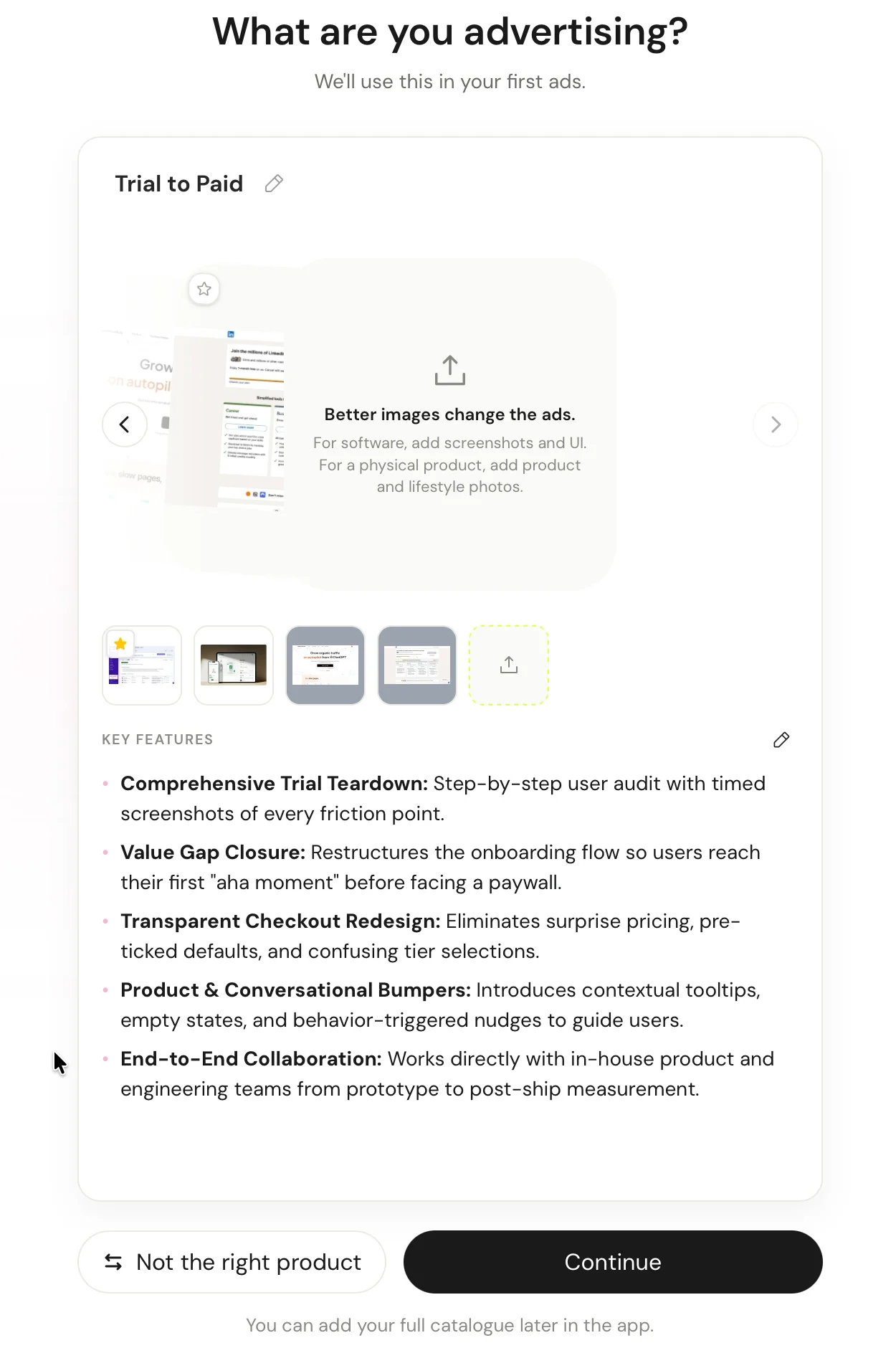
2:40 of loading so far, and two accurate answers. I'm still in.
4. The inspiration: pick 3 ads you like
Step 3 of 3: "Let's find a brand to inspire you." Superside, PostHog, Magier, King Kong, Leadpages. Then "Pick 3 ads you like."
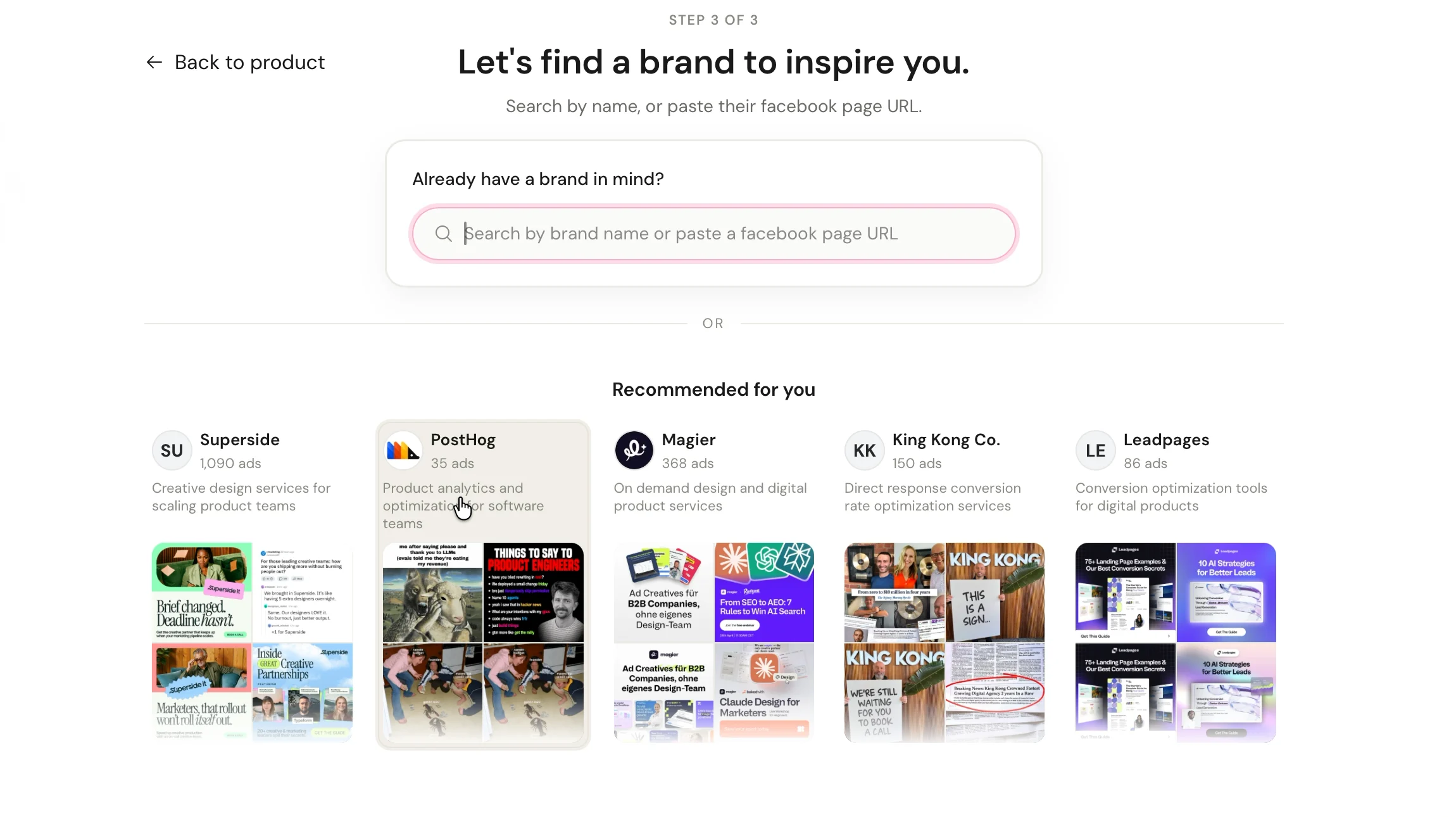
Every brand I open: 8 to 20 seconds of empty tiles. After four, I just pick three Superside ads from the list. I'm tired of loading screens by now. On a better day, I'd keep looking for a brand closer to mine. Two minutes on this step.
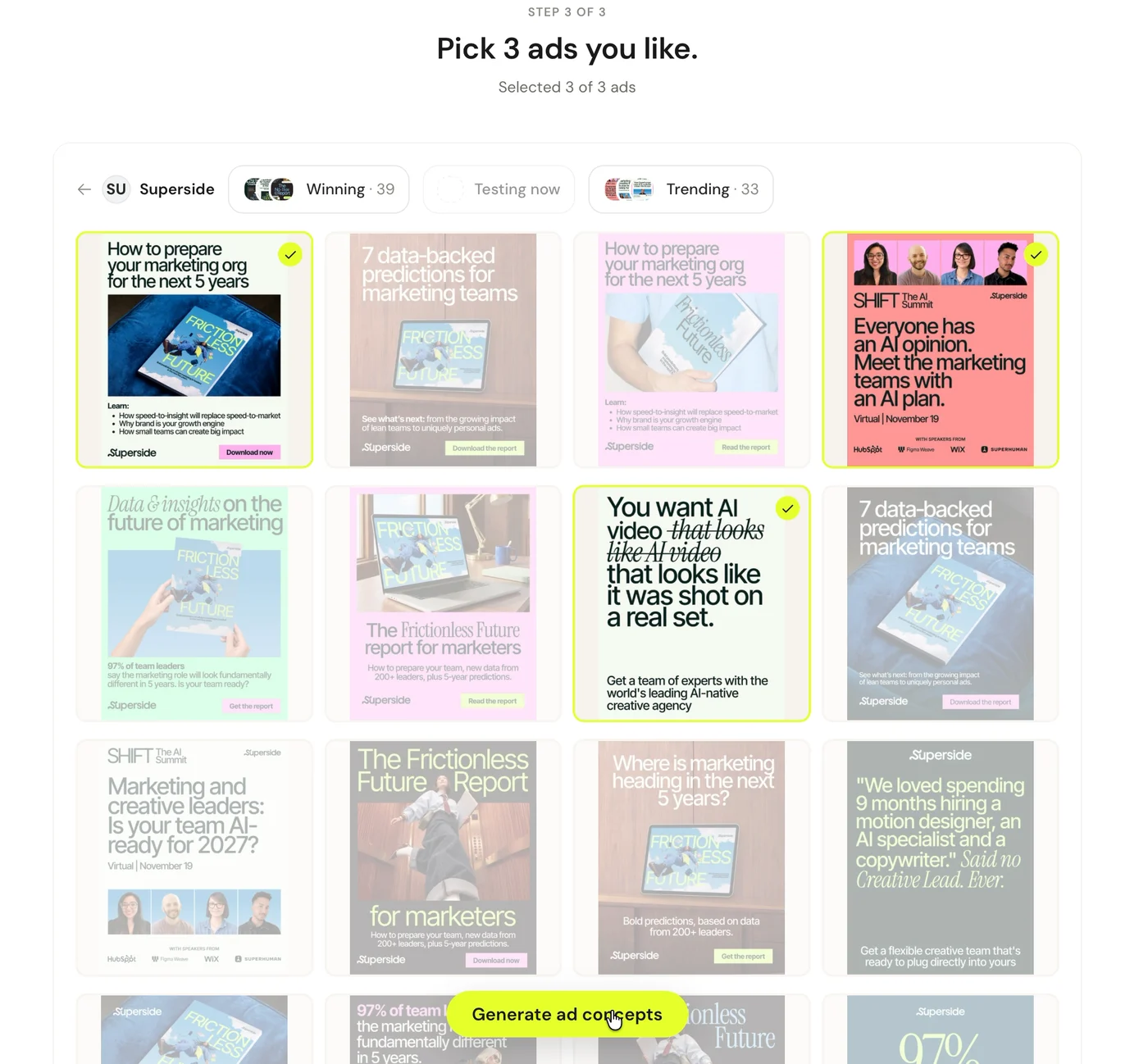
"3 ads × 1 product × 3 versions. About 9 concepts." A clear picture of what's coming.
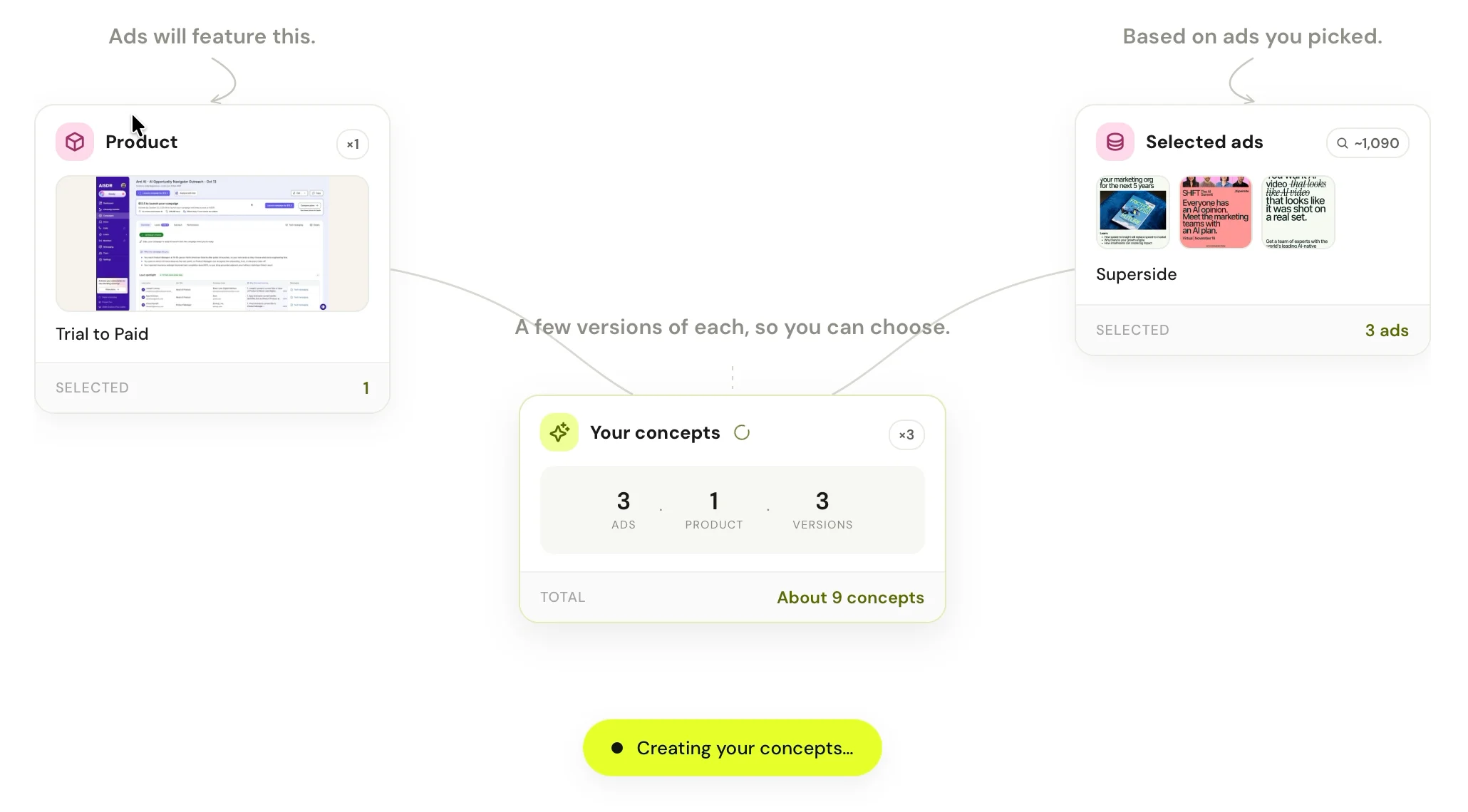
Then it spends 48 seconds typing out what the diagram just showed me, one line at a time: "Creating concepts for Trial to Paid. Each one starts from an ad you picked. You'll get 3 versions of every ad. Pick the ones you like when they're ready." It's a loading screen dressed up as an explanation.
5. The first ads
The concepts page opens on my three Superside ads and nine dotted boxes. Another 50 seconds.
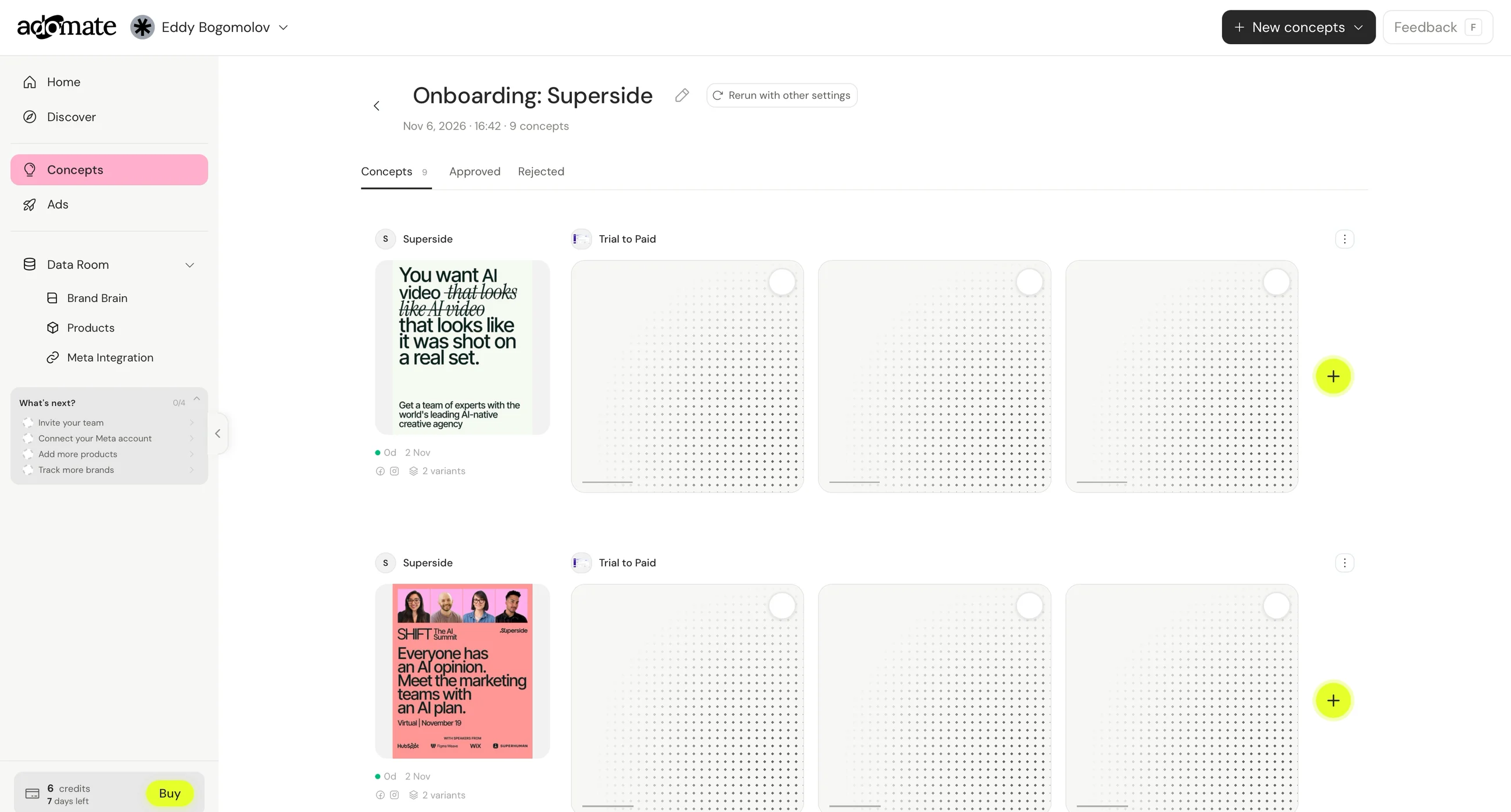
Eight minutes from the homepage to the first ad. Five of them were loading screens.

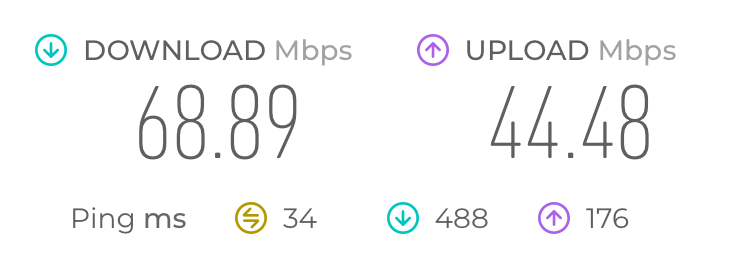
Maybe my internet is slow? I ran a speed test: 68.89 Mbps down, 44.48 up, 34 ms ping. It's not my internet. The waiting is Adomate's.
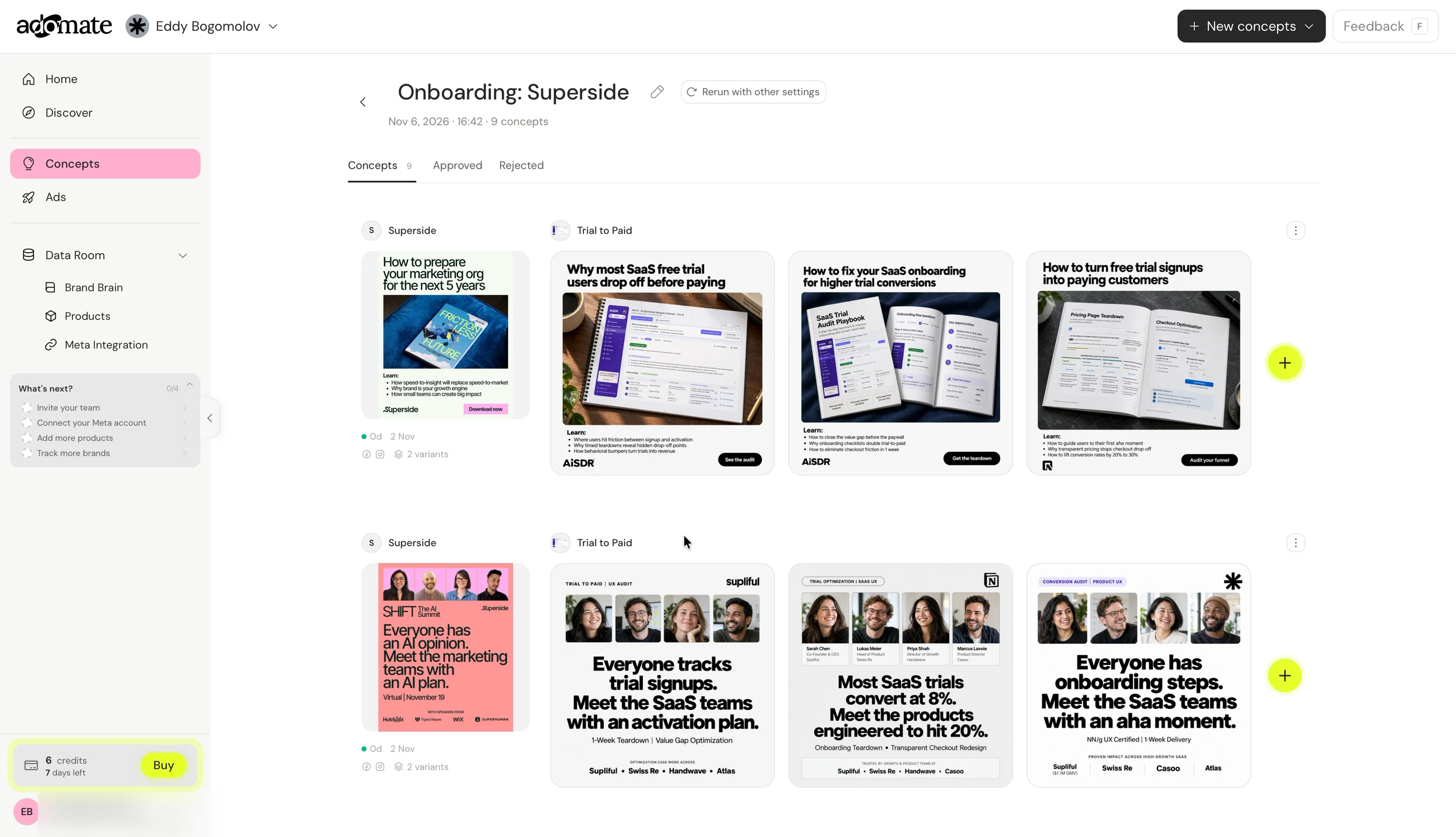
Then there they are. My real clients, my NN/g certificate, my $1.1M GMV case study. It read everything.
For about four seconds this is the best trial I've done. Then I open one.
I open the first ad, and I can't publish it. Four people vouch for me, and none of them exist. The logo in the corner is Notion's, not mine.
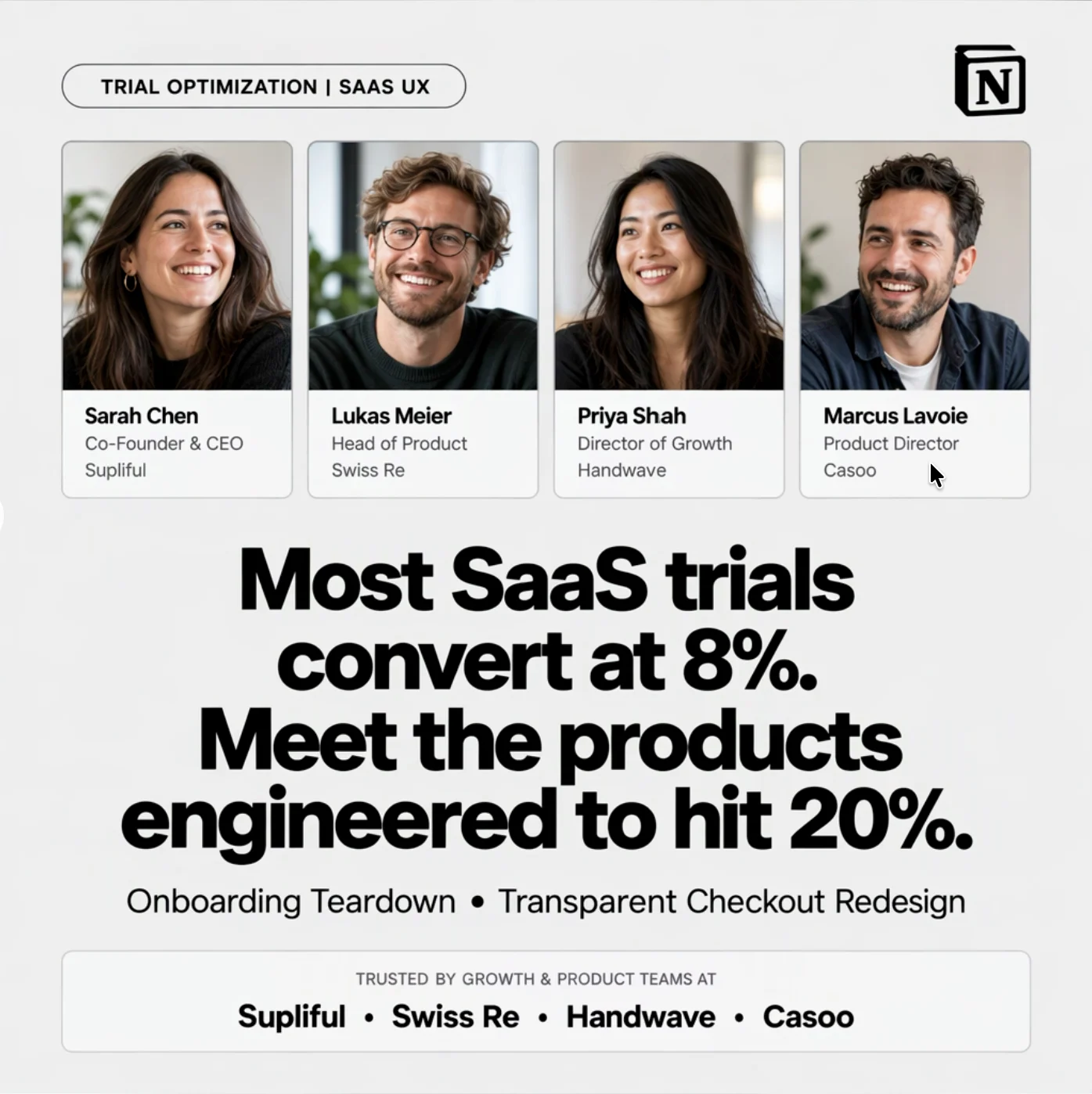
Here's how: Adomate took my real client list, Supliful, Swiss Re, Handwave and Casoo, and invented a face and a job title for each. "Sarah Chen, Co-Founder & CEO, Supliful" is a made-up person at a real company. So are Lukas Meier at Swiss Re, Priya Shah at Handwave and Marcus Lavoie at Casoo.
The row above: three ads signed "AiSDR". AiSDR is a product I wrote a teardown of, not my brand.
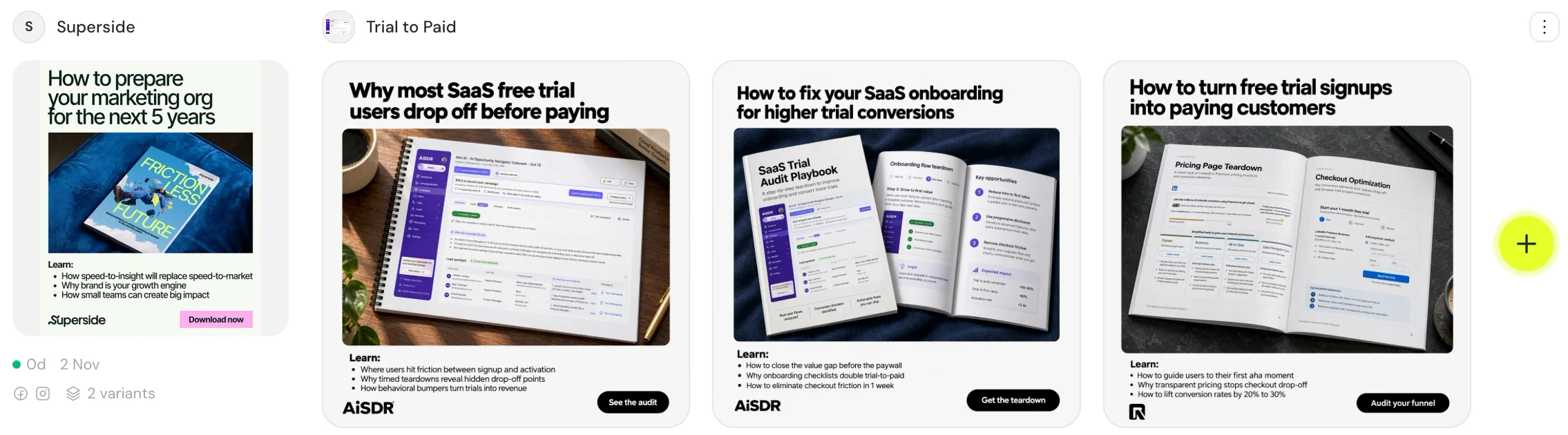
So the Brand Brain kept its one rule, "never present Eddy Bogomolov as a SaaS software subscription tool", and broke the bigger one: don't put words, faces or logos in my ads that aren't mine.
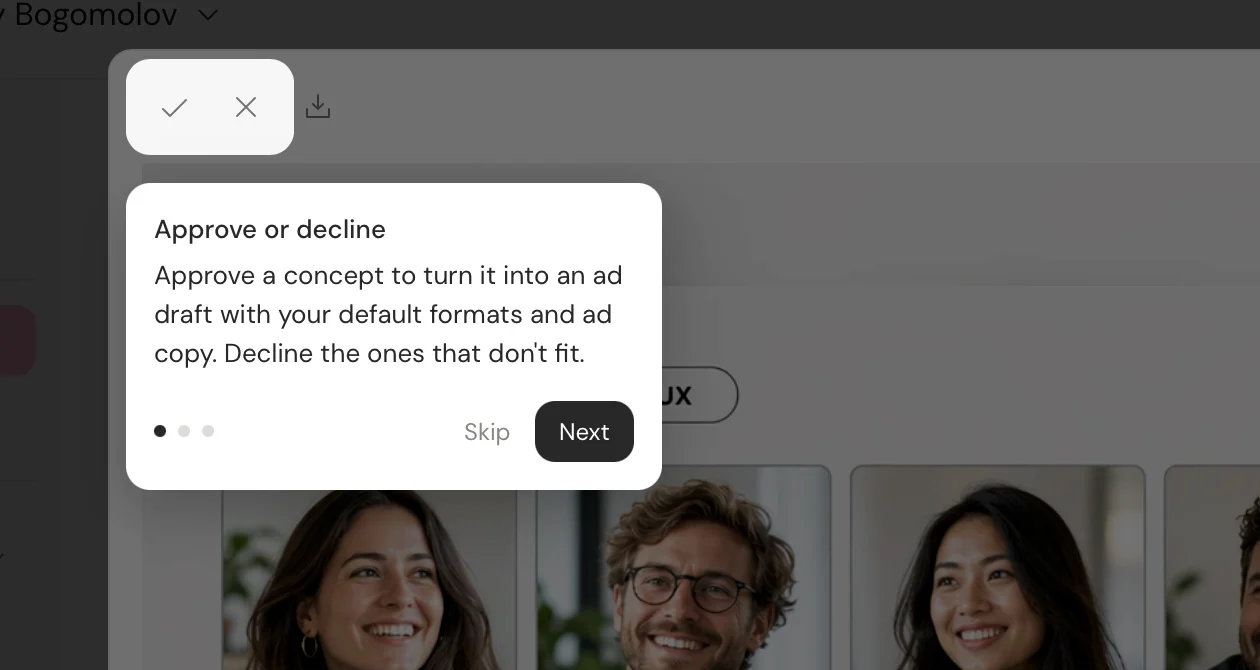
The tour comes too late: only after the ads are made, with one already open, does it explain "Approve or decline". And the buttons it points at are two small icons in the corner, a ✓ and an ✕.
Then "Keep exploring: 6 credits", valid for 7 days. Nine concepts plus six credits: the 15 free ads the homepage promised. That part is honest.
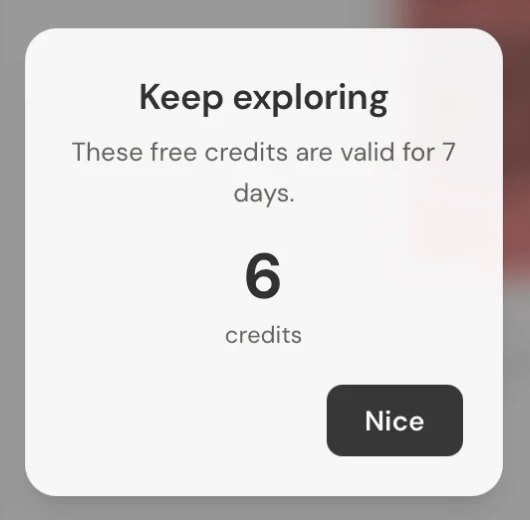
Credits only convert when the first outputs make people want more. Gamma's users ran out of AI credits and flooded support: "How do I purchase more credits? I want to keep using this thing" (Lenny's Podcast). After four strangers at my clients, I'm not spending my six.
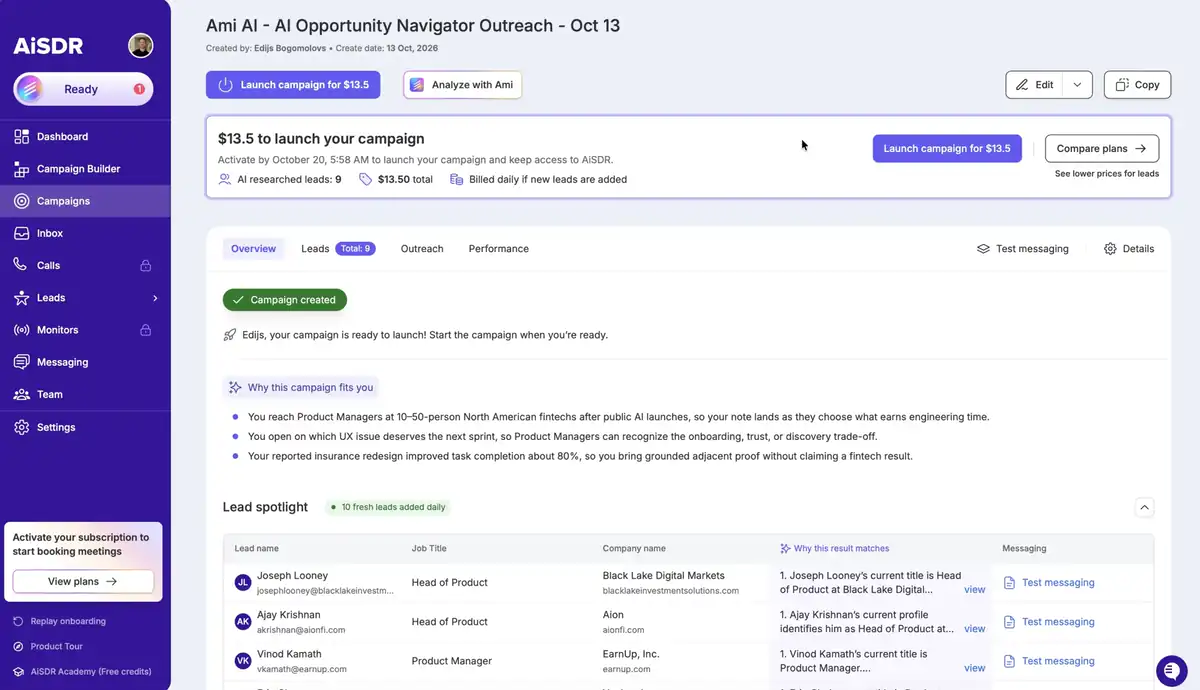
Before Adomate, I tested another AI tool that starts by reading my website: AiSDR, which finds sales leads. It took 24 minutes, but gave me nine real leads I could email. Adomate took eight minutes and gave me nine ads I can't publish.
6. How I'd redesign the concepts page
The aha is the ads: lots of them, and good. Generative AI will get some wrong, every time. So my redesign doesn't promise perfect ads. It makes a wrong one quick to fix, right on this page.
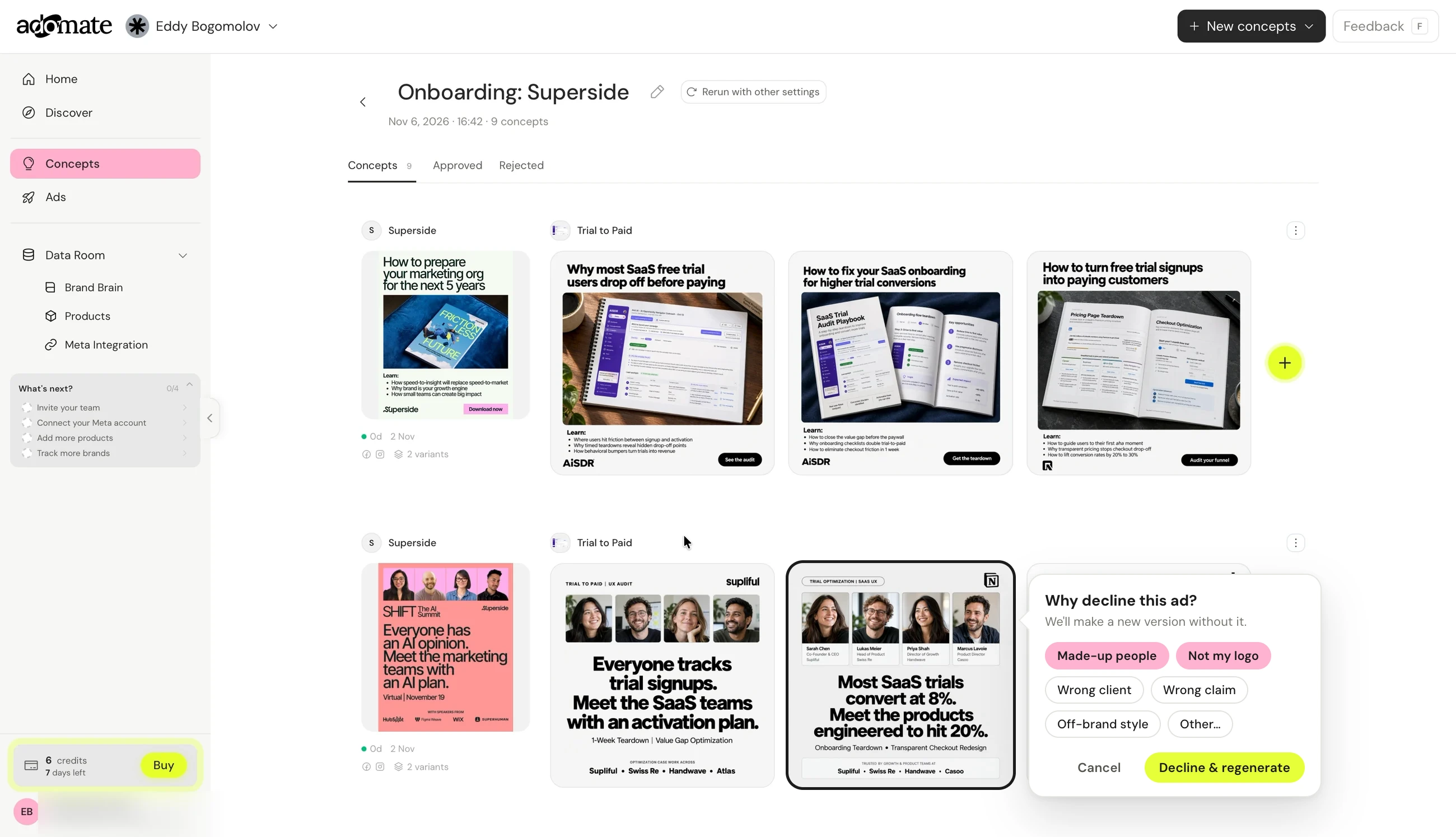
Step one: decline the ad and say why. Adomate already has "Decline". I add one question: "Why decline this ad?" Here, two taps: made-up people, and not my logo.
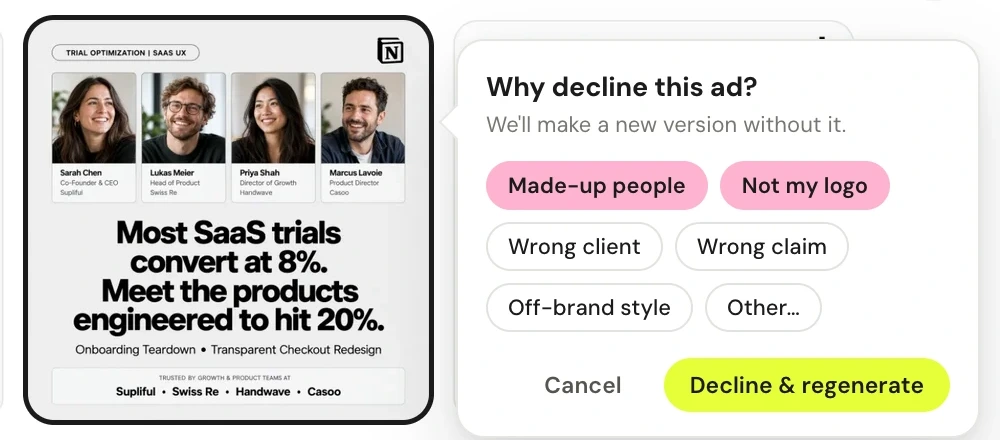
Why: "Decline" alone tells Adomate only that I didn't like it. The reason tells it what to change in the next one.
Step two: decline and regenerate. It makes a new version of the same ad, with my reasons applied. Same headline and layout, my logo, and my teardowns where the faces were.
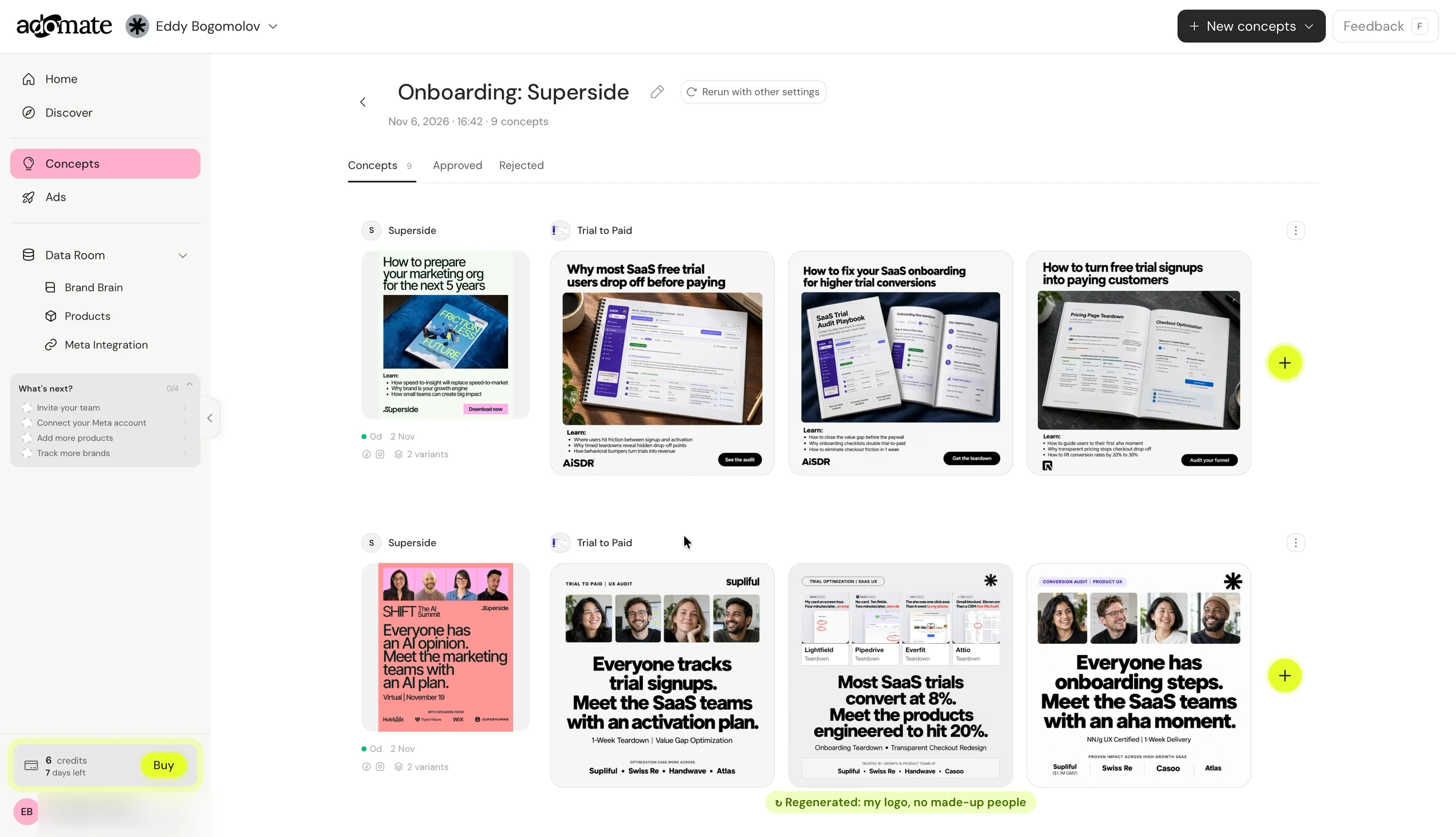
Why: I keep the idea I liked and lose only what I said was wrong. Starting over would throw away the good part. Dr. Marily Nika calls invented details like these a "Do-not-ship bar: the unacceptable failure rates that will break trust" (Lenny's Newsletter). An AI ad tool will cross it sometimes. The fix is making the way back fast.
The other ads stay as they are, so the variety I came for stays. Generative AI will keep getting some ads wrong. With this loop, a wrong ad costs me two taps, not my trust.

7. Three ways to make the first ad one I can publish
Each one uses what Adomate already read on my site.
📄 Pick from what you read
The Brand Brain read my Services page. List the products it found and let me tick one, instead of asking me for a URL. It turns a new tab and a copied link into one click.
⚡ Show one ad first
Render the first concept while the rest generate, and open on it. Adomate already does this with its questions: it asks them while it reads my site. Do the same with the ads, and with the inspiration grids.
🔍 Check every ad against the Brand Brain
Real client names, yes. Made-up people and other companies' logos, never. Show where each claim came from. The Brand Brain wrote itself one rule about me. Add three more: no invented people, no other brands' logos, no claims that aren't on my site.
Read the site once, show one ad early, ship nothing that isn't mine.
Ready at the Brand Brain, lost at the first ad
Adomate's setup won me over: just my URL, questions while it reads, and a brand summary that got me right. Then five minutes of waiting wore it down, and the first ad I opened had four strangers in it.
The whole journey, from my recording (measured on 2-second frames):
- 0:00 · Homepage: just my URL · ✅ One box
- 0:16 · Sign-up shows my domain · ✅ About me already
- 0:38 · Five questions while it scans · ✅ No waiting
- 1:00 · Brand Brain: 80 s
- 2:22 · "Here's what we learned" · ✅ Accurate
- 2:30 · "What are you advertising?" · ❌ A URL it had seen
- 2:46 · Product analysis: 80 s
- 4:16 · Inspiration: four brand grids
- 6:24 · "Generate ad concepts": 48 s
- 7:16 · Nine dotted boxes
- 8:05 · First ads · ❌ Invented people, borrowed logos
- 8:24 · Tour: "Approve or decline" · ❌ After I'd opened one
About five minutes of that is loading screens: two 80-second reads, 42 seconds of empty brand grids, 48 seconds of "Creating your concepts" and 49 seconds of dotted boxes.
The fix: Check the first ad against the Brand Brain, and show it at 2:40, not 8:05.
Product-led means no salesperson walks you through the product. The product itself has to convince you to stay and pay. To do that, a trial has to answer four questions on its own:
- Does it do what the homepage promised? Partly. It read my site and got my business, my product and my clients right. But it never asked for the performance data the headline is built on.
- Can I get in quickly? Partly. URL first and questions while it reads. Then a product URL it could have found, and two minutes picking inspiration.
- Do I see value fast? No. For an ad tool, value is an ad I could run. Eight minutes, five of them loading, to ads with invented people and other brands' logos.
- Do I know what to do next? Partly. A tour on approve and decline, and a checklist that starts with "Invite your team". I'm a team of one.
No clean yes: a brand read I'd pay for, and ads I can't use.
The ten lessons
- Use the data the headline promises · Partly
- Show the output, and the loop · ✅
- Put the customers next to the promise · Partly
- Carry the first answer into the next screen · ✅
- Ask while you work · ✅
- A good loading screen is still a loading screen · Partly
- Don't ask for what you just read · ❌
- A visual starting point, if it's fast · Partly
- A publish-ready ad has to be publishable · ❌
- Explain approve or decline early, and make it visible · ❌
Zoom out
Adomate is the most impressive setup of any trial I've recorded. It found my business, my product, my clients, my certificate and my best number without me typing any of them. That's exactly why the invented people hurt. The real details make the fake ones believable.
An AI tool's first output is its aha moment and its biggest risk at once. Most trials show something wrong on the first screen and lose a click. An AI ad tool that shows something wrong could put a stranger with a job title next to a real client's name, under my logo, in front of their whole market.
The fix isn't a better model. Adomate already has the Brand Brain: it knows what's on my site. Use it as a checklist, not just a prompt. Everything in the ad either came from my site, or it gets flagged before I see it.
If you run a trial for an AI product: look at the first output a new user sees. Could they ship it as is? If not, show them what to check before they open it, not after.
What's the first output in your trial, and would a new user ship it as is? Leave a comment. I read every one.
Further reading:
- Why AiSDR wins the trial and loses the checkout, the other AI tool that starts from my website
- Why a 3-day trial backfires when results take 90 days, an AI marketing tool with a clock that starts too early
- Counterintuitive advice for building AI products, Lenny's Newsletter with Kyle Poyar
I break down real free trials and show where they lose paying users. If this helped, send it to someone who owns a trial.
Want a teardown of your trial? DM me "teardown" on LinkedIn.
Eddy
Everfit Nailed the Sign-Up (But the Aha Happens to Someone Else)
Everfit, Nov 6, 2026