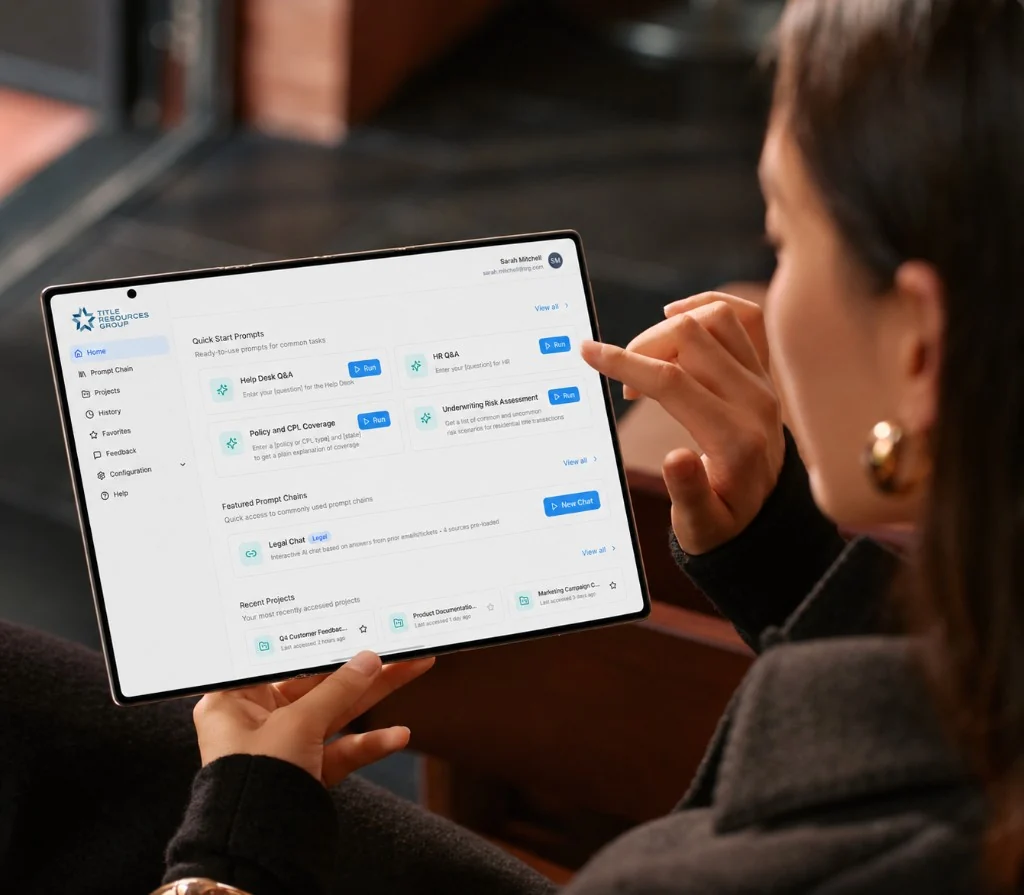
Title Resource Group's checkers did every order by hand. A checker is the person who checks the papers. The leaders set a goal for the year: cut that cost by letting AI do the work. The first tool was ready for real use in three weeks. What is live has already hit 30% of the goal.
Title Resource Group helps title agents. When someone buys a house, a title agent checks that the seller really owns it. The agent also checks that nothing is wrong with the papers: no hidden unpaid debts tied to the house, no past cheating, no mistakes. That check is called a title search. The company's tool, TitleFlow, turns each search order into the pack the agent needs to close the sale. The pack has a title report, backing papers and a bill.
This is how the work moved from all by hand to AI on every order. A checker approves the AI's work until the numbers show the AI can do a step alone.
- Client
- Title Resource Group, which helps title agents
- Product
- TitleFlow, the tool for title search orders
- My role
- AI and product adviser. I guard one rule: a person checks the AI's work. The AI does a step alone only after 99 of 100 results pass.
- Focus
- Daily work, done by AI
- How we know
- The AI does a step alone only after checkers approve 99 of 100 results.
Result
- 30%
- of the yearly savings goal, already live
- 3 weeks
- to the first tool ready for real use
- 99 / 100
- approved before the AI does a step alone
Thousands of orders a day, checked by hand
Before AI, people did every order by hand. In Pennsylvania alone, there are thousands of orders a day. One order can hold 40 or more papers.
A checker opened a pack from another company. It was one PDF, sometimes over 100 pages. They split it by hand into ownership papers, home loans, tax records and wills. Then they read each paper against a checklist and compared the land descriptions. They marked the land's border points in a separate tool, a deed plotter. Last, they picked check codes from a list of hundreds.
The rules change by state. A warning in Florida might mean nothing in Ohio. The right check code depends on the kind of paper, the state and the deal.
It was skilled work, done over and over. The leaders wanted to cut that cost.
Goal: lower cost, AI does the repeated work
The leaders had a clear goal for the year. AI would do the hand work, so the cost of doing the work would drop. They had already done the math.
AI would take the repeated work. The team could then focus on the hard calls that need a person's skill. The leaders did not want AI to do it all alone overnight.
Live in 3 weeks instead of 6 months
The first tool was ready for real use in three weeks. The team got there by using AI tools at every step, from screen design to writing code.
It began as a first test version. A person in charge, not a tech person, built it. It had only the part you see: no data store, no safety, no link to real orders. Ready for real use means all of those, in a tool thousands of people count on each day.
The designer listed what the tool must do and put it into Figma Make, an AI design tool. Draft screens came in hours. The team for the part you see wrote code with Cursor, Claude and Copilot, three AI coding tools. The team for the part you cannot see built features with Claude Sonnet and Cursor. In Jira, a task tracker, a custom helper built on Rovo, Jira's AI, wrote and fixed up notes on what users need. It used the project papers.
A small team worked as fast as a much bigger one. After the first tool, new features kept coming. The client now uses the same way of working in its own teams.
Real use showed what to build next
After the first tool, talks with users were meant to show what to build next. They did not.
The people in the talks had never used AI tools. They did not know what AI could do or what they wanted from it. The talks took longer than building the first test version. They gave a list of fuzzy points. The leaders never agreed to them or put them in order.
So the team changed the order. First build the must-have parts. Then go live. Then make it better by watching real use. The leaders gave a list of features. The team helped sort it by what helps the business most. Work moved in small, clear steps.
Safe because a person checks the AI's work
The AI does the work and the checker checks it. If 99 out of 100 results pass, the AI can do that step alone.
That rule shaped every choice after it. A step runs with no check only when the numbers say it can. Years before, other companies had tried to jump straight to letting the AI do it alone. They still had not reached the results this project already has.
With legal papers, being right every time matters more than being creative. So for quality checks, the AI gets yes-or-no questions it must follow. It does not guess freely at what might be wrong. It follows a path. If a paper talks about mobile homes, it checks the rules for that kind of paper. If not, it moves on. Every path ends in a clear answer.
Checkers also had to accept the tool. At first the AI marked problems by saying “this is incorrect.” Checkers pushed back, and complaints shot up. The fix was to rewrite every note as a tip: “We see this, but your title report mentions X. Worth a look.” Same facts, a different reaction.
What the AI now does on every order
Each skill replaces one hand step from the old way. It is a set of small AI tasks, done one after another. What goes in and what comes out is fixed.
Splitting papers
Checkers used to split the pack by hand. One PDF could be over 100 pages. Now the AI reads each page's title and text. It sorts every page and splits the pack into single papers. This runs on its own. Every later step gets clean, sorted files.
Drawing borders
Checkers used to copy border points from the land description into a separate deed plotter. Now the AI pulls them out and draws a PDF sketch of the land's borders. Users still compare the final result.
Check and search quality
The hardest part. Checkers used to run a checklist by hand on every paper in every order. Now the AI checks if the land description is right and checks grammar. It looks for warnings: water rights, mobile homes, rights other people have to use a road, wrong land sizes and wrong directions. Rules differ by state, kind of paper and deal. So yes-or-no questions the AI must follow keep results steady.
Check codes
Checkers used to search a list of hundreds of codes and choose by hand. Now the AI suggests codes for each paper's kind and state. The checker looks them over and approves.
Order chat
The newest skill. Users ask about any order and get answers from real order data. The AI has a safe way to read that data.
One AI engine that guards data and stays on
The main AI service was down for four hours. A backup that takes over switched to a spare model, and the service kept working. The AI runs in its own layer outside TitleFlow, as one engine any system can call.
TitleFlow plugs into it. The help desk is being linked now. Another in-house project, SDA, comes next. One engine serves many tools, so nothing has to be built twice.
The engine works with private legal data. The safe way for the AI to read order data sits on the open internet. So the AI never gets the real keys. The system hands out short-lived passes that open only one folder. A pass lets the AI read, not change. If a pass leaks, the harm stays small.
Some sets of tasks take 10 to 15 minutes. They run in the background, so people keep working while the AI runs.
30% of the yearly savings goal, already live
The AI skills are live in TitleFlow, and every order goes through them. With what is live, the client has already reached 30% of the yearly savings goal.
The goal was to cut cost by letting AI do the hand work. Each live skill takes over one hand step on every order. These are splitting packs, drawing borders, running quality checks and suggesting check codes.
The system was not built again. An AI layer was added. Users were moved to it step by step.
The engine is still growing. New sets of AI tasks keep going live from what real users say.
What this project teaches
People check first. AI earns each step.
Count how often the AI is right before removing the person. The 99-of-100 rule is a test. The checker is the judge. It is the same ladder Lenny's archive describes for Copilot and Cursor. First suggest. Then draft for a check. Then act alone. Each step is earned with numbers. Splitting papers is on the top step. Check codes are still on the first.
Go live fast, then learn
Users could not picture an AI tool they had never seen. A working version in their hands taught more than months of talks.
Split the task up
One job per task. Less freedom when being right matters. For live work, yes-or-no questions the AI must follow beat free thinking.
Suggest, do not blame
Tone decides if people use the tool. The same finding, written as a tip and not a judgment, changed how checkers reacted.
Use AI to build AI
Using AI for user notes, first test versions and code made three weeks possible.
Safety comes first
AI passes, tight limits and guarded entry points belong in the first round of work.