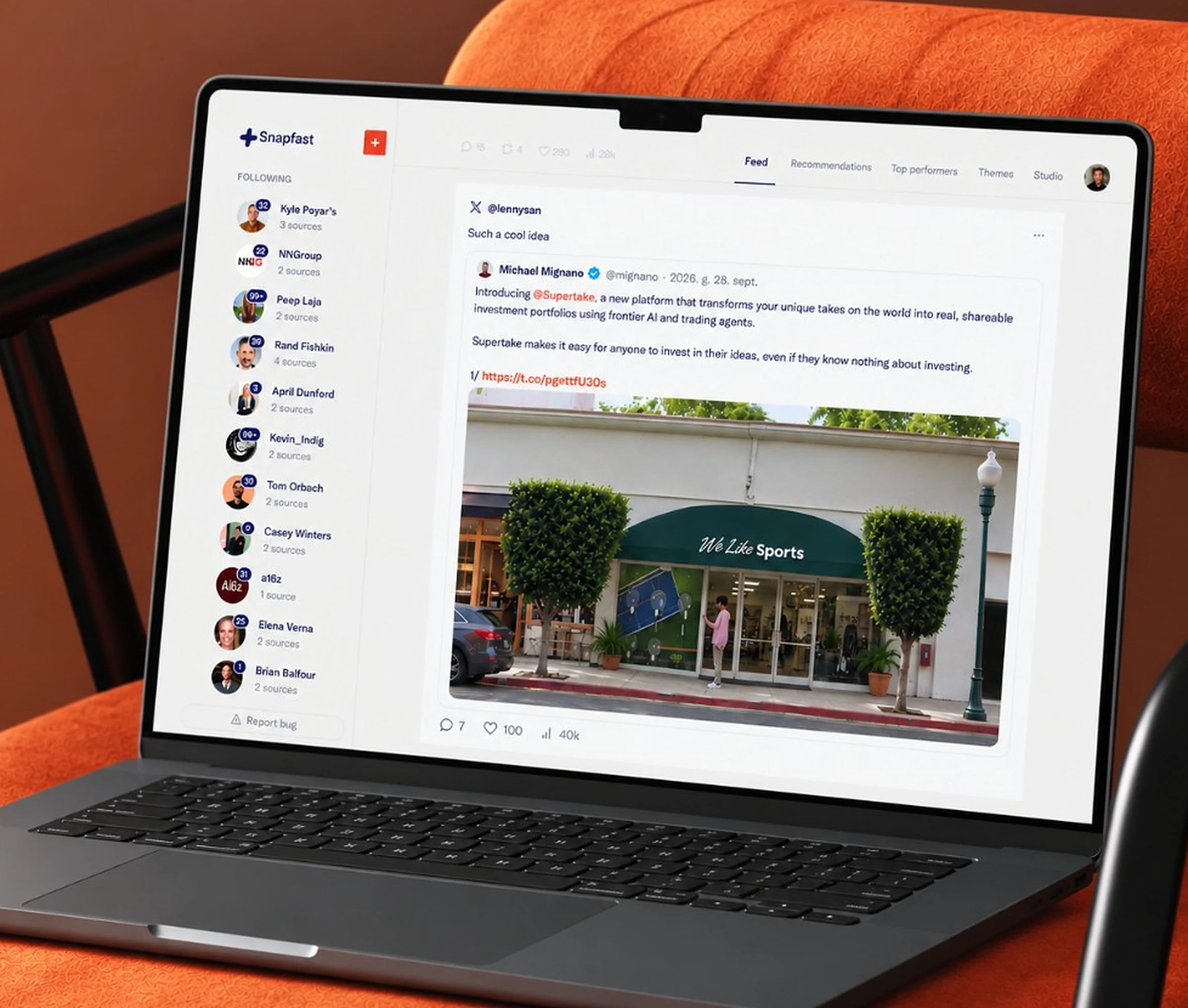
Snapfast tells creators, people who post online, what to post next. It uses real posts from people they follow and their own channels. At first, 4% of free users started paying. I rebuilt what they get on the first visit. Then it was 18%.
I started Snapfast and build the product and website myself. This page shows what was wrong, how I found it, and what I changed. It also shows what the number does and does not prove.
- Product
- Snapfast, an AI tool that tells creators what to post next
- My role
- I started and built it: research, design, code, and the instructions I give the AI.
- Team
- Just me, building with Cursor, an AI coding tool
- Focus
- Free users who start paying
- How we know
- Several changes went out together, so the result belongs to them all.
Result
- 4% → 18%
- free users who started paying, 4.5 times more
- 4
- idea cards on screen each day, each tied to real posts
- 0
- posts sent out without the creator
The free version was the problem, not price
Free users got most of the useful parts without paying. So 4 in 100 paid.
The free version was a library of proof: real posts, times, links, likes and comments. No summary of what matters. It built trust, but it did not help in the morning. A library you can scroll is still a library you must read. So a creator who browsed it for free still had to pick what to post.
Watching people work showed more than asking
I found the problem by watching creators work. Then I gave them an idea card they could say no to.
Interviews did not show it. People who never had a post plan backed by proof cannot ask for one. So they ask for summaries, alerts, and “what’s trending.”
The pain that lasts is the blank page. Creators need something to say today. It should build on what worked for people they study and their own followers. It is also a daily job. Dan Hockenmaier says customers forget products they rarely use. Hila Qu’s answer is to move the product to a job people do more often. She says not to chase tricks to get people who keep coming back. Picking what to post happens every morning.
Four changes for free users
The library stayed. What a new user sees first changed. Here was my bet. Give a free user a decision to act on today, not a list to scroll. Then they have a reason to pay.
A decision on the first visit
The home screen shows the day’s cards, not the list of posts. Four are on screen, two are spare. A new user sees a post they could make today, on their topic.
Proof on every card
Each card has a short plan, a why line with real counts, and one to three proof posts. It names a kind of post on a channel the creator really uses. The numbers in the why line must match the counts on those posts. If a card says a video “said” something, the video must really say it. If not, the card is dropped.
A draft one click away
“Draft this” opens Studio, the writing screen, with the card, the proof posts, and a voice note. One click turns an idea into something you can post. So people get something useful before the free try-out ends.
Front page, free try-out, and sign-in
The top of the front page, the free try-out, and sign-in changed. I followed what people did, not a made-up profile of a user.
The result: from 4% to 18%
Free users who start paying went from 4% to 18%, 4.5 times more.
The cards, front page, free try-out, and sign-in changes all went out together. So the result belongs to the whole update. I cannot say which change moved the number most.
I track one thing, and it is not a click. The creator posted the card, and it beat their usual likes and comments. That is the sign that someone will keep paying.
What did not work first
Two earlier tries failed before this one.
A tool for a once-in-a-while job
The first Snapfast was a different tool. You compared web links or got ready for a meeting, a few times a month. In six months it got 286 visitors and $7.
Selling saved time
At first I promised no more jumping between X, YouTube, and Instagram. People did not pay for that.
How I could test so fast
I build the whole product in one loop.
I work on the code with Cursor. Every part gets built the same way. That means collecting posts, sorting them, the instructions I give the AI, and the sales page. I change a rule and watch a real card. Then I fix the check that let a bad card through. That speed let me keep testing the free version.
What happens next
The loop keeps going, using what creators do with each card.
Each new set of cards sees the last 30 days. It sees thumbs up or down, the reason, and what happened after. A rejected idea does not come back. Something they loved comes back on a new topic. The AI suggests, and the creator says yes, says no, drafts, or skips. Posting stays with the person.
What this project teaches
People pay for what they use often
People forget a tool they need a few times a month before they pay for it. A daily job gave people a reason to come back, and a reason to pay.
Sell the decision, not the library
Free users can get most of a library just by looking around. A decision they can act on today is worth paying for.
Find the sign that someone will keep paying
“Posted it, and it beat their usual” follows advice from Lenny's archive. Pick an action that goes with the result, like Snyk's one fix in 30 days. Clicks, thumbs, and opens are only early steps.
Trust makes people pay
“556 likes yesterday” can be checked. “This is the winning strategy” cannot. People pay for what they can check.